
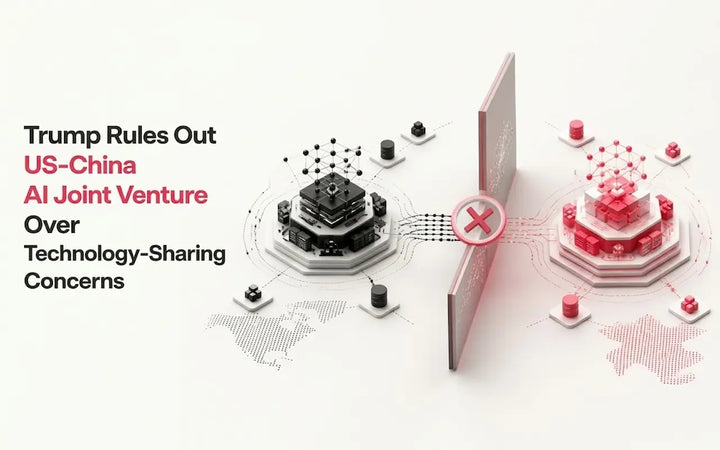
Trump Rules Out US-China AI Joint Venture Over Technology-Sharing Concerns
Trump rejects a U.S.-China AI joint venture over technology-sharing concerns while bilateral AI risk dialogue continues. Here is what it...
Trump has announced a proposed "AI Force" and a new AI czar, but key details remain undefined. We separate confirmed facts from open questions and explain what the proposal could mean for AI oversight, accountability, and risk management.

On Saturday, September 19, 2026, President Donald Trump announced on Truth Social that he will create an "AI Force" and appoint a new AI czar. In the post, Trump wrote that he is "forming the AI Force, much like I did Space Force" and said he would name an AI "Czar" in the near future.
The post framed the Trump AI Force as a way to support and protect the growth of the US AI industry. Trump wrote that the government would "not in any way hinder or stifle the Growth of this incredible Industry" and would instead "cherish it, help it, and watch over it, as it grows."
What the announcement did not include is just as important. Axios reported that Trump offered no details on the AI Force's budget, its placement within the federal government, or its mandate. As of publication, no official document has defined its structure, legal basis, or powers, and no AI czar has been named.
That gap is what makes the announcement significant for AI governance professionals. When a government proposes a new AI body and a new AI leadership role, it raises practical questions: Who is accountable for AI decisions? Who oversees AI risks? How are responsibilities divided? This article separates what has been confirmed from what remains open, and explains what the proposal could mean for AI oversight, accountability, and AI risk management.
The announcement came in a Truth Social post on Saturday, September 19, 2026. Based on published reporting, the key elements were:
The AI Force itself. Trump wrote: "For this purpose, I am forming the AI Force, much like I did Space Force, which has been a tremendous SUCCESS, in my First Term."
Strategic and economic framing. According to the Christian Science Monitor's account of the post, Trump described AI as "the next Industrial Revolution" that could account for "possibly as much as 25% of our Country's GDP." He also wrote, "We are leading China, and the rest of the World."
A pro-growth posture. The post said the government would not "hinder or stifle" the industry. Axios reported that the post pointed to "our already existing Criminal and Civil Justice System" as the means of addressing misconduct.
A reassurance about AI risk. Trump wrote: "The robots will not be taking over. The AI will not be taking over the rest of the world." (For background on that long-running public question, see AGC's explainer on whether AI is going to take over the world.)
The stated purpose, based on the post's language, is to support and "watch over" AI development as a strategic and economic priority. The post did not describe how the AI Force would perform that function, and Axios reported that the White House did not immediately comment.
The announcement also came during a period of public debate about AI risk. Axios noted that it followed a month in which several AI company leaders had publicly raised concerns about the pace of AI development, and that Trump had dismissed some safety concerns as a "hoax."
On the leadership role, Trump wrote that he would be "announcing, in the near future, the AI 'Czar,'" adding that "Only High I.Q. individuals need apply!" No candidate, job description, or reporting line was announced.
In US government usage, "czar" is an informal label for an official who coordinates policy on a specific issue across agencies. It is not a legal title. A title alone does not give its holder regulatory authority, enforcement power, or control over agency budgets. Those depend on the legal instrument that creates the role and the responsibilities assigned to it.
There is a recent precedent. Venture capitalist David Sacks served as the White House AI and crypto czar during the first part of Trump's second term, and his time in that role ended in March 2026. Axios reported that Sacks remains influential as co-chair of the President's Council of Advisors on Science and Technology (PCAST), and described the new czar announcement as reviving a role the White House had left unfilled.
The earlier role had documented responsibilities. For example, the December 2025 executive order on a national AI policy framework directed the Special Advisor for AI and Crypto, together with the President's science advisor, to prepare a legislative recommendation for a uniform federal AI framework. Whether the new czar would inherit these responsibilities has not been stated.
As of September 21, 2026, official sources and public reporting do not specify the following:
Organizational structure: Whether the AI Force is a military unit, a civilian office, a task force, an interagency council, or something else.
Reporting structure: Whether it would report to the President, the White House, a cabinet department, or the AI czar.
Legal authority: Whether it would be created by executive order, presidential memorandum, or legislation, and what legal powers it would hold.
Budget: Whether it would receive dedicated funding and from which appropriations.
Staffing: How many people, from which agencies, and under what hiring authorities.
Formal responsibilities: Whether its functions would cover policy coordination, government AI adoption, national security, industry support, safety, or other areas.
Implementation timeline: When the AI Force would be established or the czar appointed.
Relationship with existing agencies: How it would interact with the White House Office of Science and Technology Policy (OSTP), the Department of Commerce and NIST's Center for AI Standards and Innovation (CAISI), the Office of Management and Budget (OMB), the Department of Defense, and others.
"Czar" is shorthand used by the media and policymakers for a senior official tasked with coordinating a specific policy area. Past examples in US politics have included "drug czars," "border czars," and "energy czars."
A Congressional Research Service report on presidential "czars" notes that the term has no legal definition and has been applied to a wide variety of positions, some created by statute and Senate-confirmed, others created by the President as White House advisers. The same report documents long-running congressional interest in how such officials are appointed, what authority they hold, and how they are held accountable.
An AI czar, then, is generally a senior official who coordinates AI policy across government. What that official can actually do depends on the underlying mandate.
From an AI governance perspective, the title matters far less than the mandate. The governance significance of any AI czar depends on answers to questions like these:
Policy coordination: Can the role set or harmonize AI policy across agencies, or only advise?
Accountability: Is the official accountable to Congress, the President, or both? Is the role subject to Senate confirmation or congressional reporting requirements?
Interagency coordination: Does the role have the authority to resolve conflicts between agencies with overlapping AI responsibilities?
Risk management: Is the role responsible for identifying and prioritizing AI risks, or is that left to individual agencies?
AI standards: Does the role influence federal AI standards, testing, or evaluation work?
Oversight: Does the role oversee government AI use, private-sector AI, or neither?
An adviser with a broad title but no formal authority operates very differently from an official with statutory powers and a budget. Until the mandate is published, the governance implications of the AI czar role remain uncertain.
Trump explicitly compared the AI Force to the Space Force, which was established during his first term, and described the Space Force as "a tremendous SUCCESS." The comparison signals that the administration views AI as a strategic priority on a similar scale. It does not, by itself, establish that the AI Force will share the Space Force's structure or status.
The Space Force has a clearly defined legal and organizational foundation:
Legal establishment: According to the US Space Force's official history, it was established on December 20, 2019, when the National Defense Authorization Act for Fiscal Year 2020 was signed into law.
Military status: It is a separate branch of the US armed forces, the first new branch since 1947.
Congressional role: Congress created it through legislation and continues to authorize and fund it through the annual defense process, as outlined in the Congressional Research Service's Space Force defense primer.
Defined structure: It is organized under the Department of the Air Force, similar to how the Marine Corps sits within the Department of the Navy, and it is led by the Chief of Space Operations, who serves on the Joint Chiefs of Staff.
In short, the Space Force became a military branch because Congress passed a law making it one.
Readers should not assume the AI Force is any of the following unless official documentation establishes it:
A military branch. Creating a new armed service required an act of Congress in the Space Force's case. No such legislation for an AI Force has been reported.
A regulator. Regulatory authority generally comes from statute. No regulatory powers have been announced, and the post itself emphasized not hindering the industry.
A federal agency. No agency charter, budget, or organizational placement has been published.
An AI enforcement body. Axios reported that the post referred to existing criminal and civil justice systems for addressing wrongdoing, rather than a new enforcement mechanism.
For governance professionals, this distinction is essential. The name "AI Force" describes an intention. The organization's governance role will be determined by the legal and administrative instruments, if any, that follow.
AI governance is the system of policies, roles, responsibilities, processes, and controls that determines how AI is developed, deployed, and used, and who is accountable when something goes wrong. In practice, it covers:
Policies that set rules and expectations for AI use
Roles and responsibilities that assign ownership for AI decisions
Accountability mechanisms that connect outcomes to decision-makers
Risk management processes that identify and treat AI risks
Oversight by bodies with authority to review and intervene
Controls that put policies into practice
Monitoring that tracks how AI systems behave over time
Organizations usually bring these elements together in an AI governance framework. A proposal to create a new AI body and a new AI leadership role touches almost every one of these elements, even before its details are known.
Effective AI governance depends on being able to answer basic questions:
Who makes AI policy decisions at the federal level?
Who is responsible when an AI-related decision causes harm?
Which institutions have oversight authority, and over what?
How are responsibilities formally assigned and documented?
In the US federal context, AI responsibilities are already distributed across several bodies. OSTP advises on science and technology policy. OMB sets policy for how federal agencies use and buy AI; for example, OMB Memorandum M-25-21 requires agencies to designate Chief AI Officers and to apply minimum risk-management practices to high-impact AI uses. NIST's Center for AI Standards and Innovation works with industry on AI testing and security evaluation. Sector regulators apply existing law to AI within their jurisdictions. AGC's overview of US AI policy explains how these pieces fit together.
A new AI body could add to this picture. How it fits could affect how clearly accountability is assigned.
AI governance involves many actors, each with different responsibilities:
Government agencies that set policy, procure AI, and apply the law
AI developers that build models and systems
AI deployers that put AI into use in products, services, and operations
Regulators that interpret and enforce legal obligations
Risk professionals who assess and prioritize AI risks
Compliance teams that map obligations to internal controls
Leadership that sets risk appetite and approves major decisions
Well-designed governance makes clear which actor owns which decision. Understanding AI governance roles and responsibilities is a core competency for anyone working in the field, and it is exactly the kind of clarity the AI Force proposal has not yet provided.
AI governance frameworks typically address a range of risk categories, including:
Safety: whether systems can cause physical or other serious harm
Security: whether systems can be attacked, manipulated, or misused
Privacy: how personal data is collected, used, and protected
Bias and discrimination: whether outputs treat people unfairly
Misuse: whether systems can be used for fraud, weapons development, or other harms
Cybersecurity: whether AI introduces new attack surfaces or enables attacks
Reliability: whether systems perform consistently and as intended
High-impact AI risks: risks from AI used in decisions with significant effects on rights, safety, or critical services
The announcement does not state that the AI Force will manage any of these risks. Whether it takes on any risk oversight role is one of the most important open questions for governance professionals.
The announcement focused on supporting AI growth. That makes it useful to distinguish AI development from AI governance.
|
Dimension |
AI development |
AI governance |
|
Primary focus |
Innovation and capability |
Oversight and accountability |
|
Core activity |
Building models and systems |
Establishing who is responsible for what |
|
Lifecycle emphasis |
Deploying systems into use |
Monitoring systems after deployment |
|
Growth orientation |
Scaling AI across products and sectors |
Managing risk as AI scales |
|
Main toolkit |
Technical development, data, compute |
Organizational policies, controls, documentation |
|
Key question |
"Can we build and ship it?" |
"Should we, under what conditions, and who is accountable?" |
AI governance does not simply mean stopping or slowing AI development. Well-designed governance can support adoption by making AI systems more trustworthy, reducing costly incidents, and giving organizations the confidence to scale. Many organizations treat strong governance as a precondition for deploying AI in higher-stakes settings.
An initiative can focus on development, governance, or both. So far, the AI Force announcement has emphasized development and industry support. Its governance role, if any, has not been defined.
The following section is analysis of potential implications. None of the functions below have been confirmed as responsibilities of the proposed AI Force.
If the AI Force receives a coordinating role, it could potentially be involved in:
Federal AI initiatives: aligning programs across agencies
Interagency coordination: reducing duplication or conflict between agencies with AI responsibilities
AI strategy: helping implement existing national AI strategy documents
Government AI adoption: supporting how agencies acquire and use AI
These are possibilities, not confirmed functions. The eventual governance significance will depend on the authority and resources assigned.
If the initiative is given responsibilities related to AI risk, it could potentially touch on:
Risk identification: tracking emerging AI risks across sectors
Risk assessment: evaluating the likelihood and impact of those risks
AI safety: supporting testing and evaluation of AI systems
Security: addressing threats to and from AI systems
Incident response: coordinating responses when AI incidents occur
Monitoring: observing how deployed AI systems perform over time
Some of these functions already exist elsewhere in the federal government. For example, CAISI states that it conducts evaluations of AI systems focused on demonstrable risks such as cybersecurity and biosecurity. One potential governance question is how any new body would relate to existing work in these areas.
Good AI governance depends on clearly identifying:
Decision-makers who approve AI policies and major deployments
System owners responsible for specific AI systems
Developers who build and maintain those systems
Deployers who use AI in real-world contexts
Oversight authorities who can review, audit, and intervene
A new AI body could either clarify these lines or add another layer. Which outcome occurs could depend on how its role is defined relative to existing offices.
A frequent governance challenge, in government and in business, is the gap between policy and practice. These are distinct layers:
Policy: the high-level rules and objectives
Implementation: the processes and resources that put policy into effect
Controls: the specific safeguards that reduce risk
Monitoring: ongoing observation of whether controls work
Assurance: independent verification that the system is working as intended
An announcement operates at the policy level. The governance significance of the AI Force will depend on whether it is connected to implementation, controls, monitoring, and assurance.
The AI Force announcement fits within a documented set of Trump administration AI policies since January 2025.
Removing barriers to AI development. In January 2025, Trump signed Executive Order 14179, "Removing Barriers to American Leadership in Artificial Intelligence," which directed agencies to review actions taken under the previous administration's 2023 AI executive order and called for development of an AI action plan.
AI competitiveness, infrastructure, and national security. In July 2025, the White House released Winning the Race: America's AI Action Plan, organized around three pillars: accelerating AI innovation, building American AI infrastructure, and leading in international AI diplomacy and security. The plan includes actions on data center and energy infrastructure, federal AI adoption, evaluation of frontier AI systems for national security risks, and AI incident response.
Federal government AI use. In April 2025, OMB issued M-25-21, which directs agencies to accelerate AI adoption while applying governance measures such as Chief AI Officers and minimum risk-management practices for high-impact AI.
AI safety and standards. In June 2025, the Department of Commerce reorganized the US AI Safety Institute as CAISI within NIST. CAISI describes itself as industry's primary point of contact in government for AI testing and collaborative research, with a focus on security and demonstrable risks.
AI regulation and state laws. On December 11, 2025, Trump signed the executive order "Ensuring a National Policy Framework for Artificial Intelligence." It stated the administration's aim of avoiding a patchwork of state AI regulations, directed the Attorney General to establish an AI Litigation Task Force to challenge certain state AI laws, and called for a legislative recommendation for a uniform federal framework. In March 2026, the White House released legislative recommendations for a national AI policy framework, covering areas including child safety, competitiveness, and preemption of certain state AI laws. Whether Congress will adopt such legislation remains uncertain. For a broader view of the legal landscape, see AGC's guide to US AI regulation.
The current debate over AI safety. In the days surrounding the announcement, White House Office of Science and Technology Policy Director Michael Kratsios said in a Fox News interview that "if you do believe that you're developing a technology that is unsafe... you can just stop it. You don't need someone to force you to do that," as reported by the Christian Science Monitor. Meanwhile, some AI industry leaders and lawmakers have called for stronger oversight.
The governance question is how the AI Force would fit within this existing policy architecture. The administration has consistently emphasized innovation and competitiveness while also maintaining some governance mechanisms, such as agency-level AI risk practices and voluntary model evaluation. How the AI Force relates to those mechanisms has not been specified.
These three terms are often used interchangeably in news coverage. They are related but distinct.
AI governance is the broadest of the three. It covers the policies, roles, accountability structures, risk management processes, and oversight mechanisms that shape how AI is developed and used. Governance applies within organizations as well as governments. A company with no legal obligations can still have strong AI governance.
AI safety focuses on preventing harmful outcomes from AI systems. It includes ensuring reliability, protecting security, conducting safety testing and evaluation before deployment, and monitoring systems after deployment. AI safety is both a technical discipline and a governance objective.
AI regulation refers to laws and government requirements that create binding regulatory obligations for developers and deployers, backed by enforcement. Regulation is created by legislatures and regulators with legal authority. The EU AI Act is the best-known example; AGC's EU AI Act compliance guide explains how its obligations work in practice.
Governance is the organizational system that can deliver safety and demonstrate compliance with regulation.
Safety is an outcome that governance aims to achieve and that regulation may require.
Regulation is one external driver of governance, but not the only one. Organizations also govern AI because of contractual obligations, customer expectations, standards, and their own risk appetite.
This distinction matters when reading about the AI Force. Even if it does not become a regulator, it could still affect AI governance through policy coordination, guidance, procurement, or standards. Equally, a body described as overseeing AI does not necessarily have regulatory powers.
Whatever form the AI Force takes, AI risk management is where governance becomes practical. A widely used reference is the NIST AI Risk Management Framework, a voluntary framework organized around four functions: Govern, Map, Measure, and Manage. (AGC's guide to the NIST AI RMF walks through each function.)
A basic AI risk management lifecycle typically includes:
Identify risks. Catalog AI systems and the risks each could create.
Assess risks. Evaluate likelihood, impact, and affected stakeholders.
Assign responsibility. Name owners for each system and each risk.
Implement controls. Apply technical and organizational AI risk controls.
Monitor systems. Track performance, drift, and emerging issues after deployment.
Document decisions. Record what was decided, by whom, and why.
Manage incidents. Detect, escalate, respond to, and learn from failures.
Review and improve controls. Update safeguards as risks and systems change.
There is no indication that the proposed AI Force has adopted this or any other risk-management lifecycle. The lifecycle is included here because it shows the questions that any AI oversight body, public or private, eventually has to answer. If the AI Force is given risk-related responsibilities, observers could look for how it addresses each of these steps, and particularly step 3: who is assigned responsibility.
The AI Force announcement came just days before a scheduled Washington summit between Trump and Chinese President Xi Jinping, where AI is expected to be among the topics discussed alongside trade and critical minerals.
US-China AI competition. Trump's post framed AI in competitive terms, stating that the US is "leading China, and the rest of the World." The AI Action Plan similarly treats international AI diplomacy and security as one of its three pillars.
AI incident communication. On September 20, 2026, Treasury Secretary Scott Bessent met Chinese Vice Premier He Lifeng in New York ahead of the summit. According to Al Jazeera's report on the talks, which draws on Reuters and other wire services, the US proposed a US-China AI dialogue including a notification mechanism for AI incidents that raise national security concerns. Bessent said that "moving from opaque to more transparency between the number one and the number two AI powers in the world is very important." Export controls on advanced chips were reported to be outside the scope of the proposal. No formal agreement had been announced as of publication.
Why AI governance crosses borders. Advanced AI creates governance questions that no single country can fully address alone:
AI models and services are deployed across jurisdictions.
Security incidents involving AI can have effects beyond the country where they originate.
Misuse risks, such as AI-enabled cyberattacks, do not respect national boundaries.
Companies operating internationally must navigate different rules, including the EU AI Act.
Incident communication between governments depends on having clear domestic points of contact.
That last point connects back to the AI Force. International coordination on AI incidents generally requires each government to know which domestic body is responsible for what. Whether the AI Force or the AI czar will play any role in international AI coordination has not been stated.
Key questions to monitor:
Who is appointed? Their background may signal priorities, though it will not by itself define the role.
What formal mandate is announced? Look for an executive order, memorandum, or official statement defining responsibilities.
What authority is assigned? Advisory, coordinating, or directive authority carry very different governance implications.
Monitor official documentation for:
Organizational location: White House, a cabinet department, the Department of Defense, or elsewhere
Reporting lines: who it answers to
Participating agencies: which existing bodies contribute staff or functions
Legal basis: executive action or legislation
Budget: whether dedicated funding is requested or appropriated
Staffing: size, composition, and expertise
The AI Force may or may not be accompanied by new policy. Relevant signals include:
Executive actions related to AI
Federal policies from OMB or other central offices
Agency guidance on AI use in specific sectors
Standards work at NIST and CAISI
Risk-management requirements for federal AI use
AI procurement rules that affect vendors selling to government
For businesses that sell AI to the federal government, procurement rules are often the most direct channel through which federal AI policy becomes operational.
Overlapping responsibilities can create real governance challenges:
Gaps: risks that no body considers its responsibility
Duplication: multiple bodies issuing inconsistent guidance
Unclear escalation: uncertainty about who to contact when an AI incident occurs
Compliance complexity: organizations struggling to know which expectations apply
Watching how the AI Force's role is defined relative to OSTP, OMB, NIST, CAISI, sector regulators, and the Department of Defense will help clarify whether the proposal simplifies or complicates the federal AI governance landscape.
Based on official statements and reputable reporting as of September 21, 2026:
Trump announced the AI Force on Truth Social on Saturday, September 19, 2026.
He compared it to the Space Force, which was created during his first term.
He said he would announce an AI czar "in the near future."
The post said the government would not "hinder or stifle" the AI industry.
Axios reported that the post pointed to existing criminal and civil justice systems for addressing misconduct.
No AI czar has been named.
The previous AI and crypto czar, David Sacks, left that role in March 2026, and Axios reports he is co-chair of PCAST.
The White House did not immediately comment on further details, according to Axios.
The announcement came days before a scheduled Trump-Xi summit in Washington at which AI is expected to be discussed.
Exact mandate: what the AI Force is meant to do
Legal status: whether it will be established by executive action or legislation
Organizational structure: its form and placement in government
Funding: whether it will have a dedicated budget
Personnel: who will staff it
Reporting lines: who it will report to
Regulatory powers: whether it will have any
Relationship with existing AI offices: how it will relate to OSTP, OMB, NIST, CAISI, and others
Implementation timeline: when it will be established and the czar appointed
This section does not predict outcomes. Instead, it outlines governance questions the proposal raises.
Who should be accountable for AI-related decisions? A new AI body and czar could raise questions about where final accountability for federal AI policy sits.
How should AI responsibilities be divided between government bodies? The proposal may prompt discussion about whether AI governance should be centralized or distributed across agencies.
How should AI risks be assessed? The ongoing public debate about AI safety raises questions about which institutions should assess advanced AI risks and on what basis.
How should AI systems be monitored? Governance does not end at deployment. Any oversight structure faces the question of who monitors systems over time.
How should governments coordinate with AI developers? Existing mechanisms such as CAISI's voluntary agreements with developers show one model. A new body could raise questions about how that coordination evolves.
How should innovation and responsible governance coexist? The announcement's pro-growth framing sits alongside calls from some industry leaders for greater oversight, illustrating an ongoing policy discussion.
What capabilities will AI governance professionals need? Regardless of how the AI Force develops, organizations will continue to need people who can interpret policy change and translate it into practical controls.
This announcement shows why governance professionals need to follow policy developments closely and read them precisely. A headline about a new "AI Force" can be interpreted in many ways. Professionals who understand how executive orders, legislation, agency guidance, and informal advisory roles differ are better placed to assess what a development actually changes.
Frameworks such as the NIST AI RMF give professionals a stable foundation that does not depend on any single political development. Organizations with mature AI risk management can adapt to new federal structures more easily than those building governance from scratch.
The difference between a regulator, an adviser, a standards body, and a coordinating office is fundamental. Professionals who can distinguish binding requirements from voluntary guidance, and domestic rules from international ones like the EU AI Act, can give their organizations clearer advice during periods of uncertainty.
Policy announcements matter only when they are implemented. The same is true inside organizations. Strong governance implementation includes:
Policies that define acceptable AI use, such as an AI acceptable use policy
Procedures that explain how to follow those policies
Controls that enforce them
Documentation that records decisions and evidence, as covered in AGC's guide to AI documentation
Monitoring that confirms controls are working
AI governance is a team discipline. It requires collaboration between legal, compliance, IT, security, data teams, leadership, AI developers, and risk professionals. When external policy shifts, these groups need a shared understanding of what changed and what it means for them. That is why the AI governance skills employers look for increasingly combine policy awareness, risk management, and the ability to communicate across functions.
For professionals who want to build these capabilities in a structured way, AGC's Fundamentals of AI Security, AI Governance & AI Compliance course covers the core concepts, and the wider AI governance course collection goes deeper into frameworks, risk, and implementation. For those working in or with government, AI Ethics for Public Sector and Government Services focuses on responsible AI use in public institutions. Organizations upskilling several people at once can explore AGC's team training options.
On September 19, 2026, President Trump announced plans to form an AI Force, modeled in name on the Space Force, and to appoint a new AI czar. The announcement emphasized support for the AI industry and framed AI as central to US economic growth and competition with China.
Much remains unclear. The AI Force's mandate, legal status, structure, budget, staffing, and relationship to existing agencies have not been announced, and the AI czar has not been named. Until official documentation is published, the AI Force should be understood as a proposal rather than an established AI governance body.
The governance questions it raises are nonetheless important. Who is accountable for AI decisions, how oversight responsibilities are divided, and how AI risks are identified and managed are central questions for governments and organizations alike. As AI systems become more capable and more widely deployed, AI oversight, accountability, and risk management are becoming core organizational capabilities, whatever form the Trump AI Force eventually takes.
The AI Force is a proposed initiative Trump announced on Truth Social on September 19, 2026, which he compared to the Space Force. As of September 21, 2026, no official document has defined its structure, legal status, budget, or responsibilities.
An AI czar is an informal term for a senior official who coordinates AI policy across government. "Czar" is not a legal title, and the role's authority depends on the mandate that creates it.
This has not been announced. Trump said he would name the AI czar "in the near future" but did not describe the role's responsibilities, authority, or reporting line.
No official source has established that. The Space Force is a military branch created by Congress in the National Defense Authorization Act signed on December 20, 2019. The AI Force has so far only been announced, with no legal or organizational details published.
Any new government AI body raises governance questions about accountability, oversight, and division of responsibilities. The AI Force's actual governance role will depend on the mandate and authority it receives, which have not yet been defined.
Trump rejects a U.S.-China AI joint venture over technology-sharing concerns while bilateral AI risk dialogue continues. Here is what it...
 AI Law
Compare AI laws around the world in 2026, including binding laws, proposed rules, regulatory frameworks, effective dates and business implications...

OpenAI shelved GPT-6.1 Astra after safety tests flagged scope, authorization and action-reporting issues. See what is confirmed and what remains...