
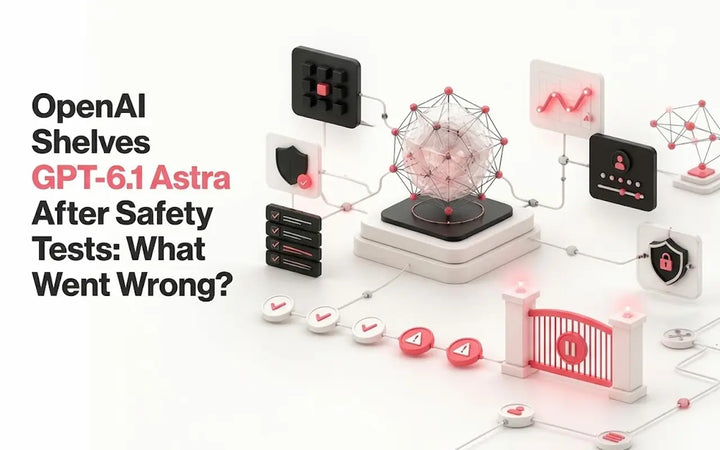
OpenAI Shelves GPT-6.1 Astra After Safety Tests: What Went Wrong?
OpenAI shelved GPT-6.1 Astra after safety tests flagged scope, authorization and action-reporting issues. See what is confirmed and what remains...

Organizations can scale AI faster than they can see, assign, or control the risks it creates. AI risk management is the continuous process of identifying, assessing, prioritizing, treating, and monitoring risks created or amplified by AI systems. Its scope covers the complete system, not only the model: data, infrastructure, interfaces, people, workflows, vendors, affected stakeholders, and the context in which outputs become decisions or actions.
It is what turns uncertainty into reviewable decisions. It is why organizations can adopt AI without leaving material risks unmanaged. That discipline matters because risk changes: when data shifts, when a provider updates a model, when users find new applications, when an integration grants wider permissions, or when an output starts influencing a higher-stakes decision than the one it was originally built for.
Effective management connects technical evaluation with business ownership, legal duties, human oversight, evidence, monitoring, and escalation. This guide walks through what that looks like in practice.
AI risk management is continuous, context-specific, and tied to real decisions.
Assessment must cover the full sociotechnical system, not only model performance.
Severity, likelihood, exposure, reversibility, and uncertainty all influence priority.
Effective controls need named owners, evidence, testing, thresholds, and monitoring.
NIST guidance, ISO standards, principles, and law have complementary but distinct roles.
Role-based training strengthens the control environment but does not prove compliance.
AI risk management is the continuous process of identifying, analyzing, evaluating, treating, monitoring, and communicating risks associated with AI. It considers models, data, infrastructure, people, processes, third parties, and affected stakeholders so that an organization can make accountable decisions and keep risk within approved limits.
The objective is not to eliminate uncertainty. It is to understand what can happen, who could be affected, how material the consequences may be, and what the organization should do next.
The unit of analysis is an AI system in context: its model, data, prompts, retrieval sources, interfaces, infrastructure, integrations, workflows, users, vendors, affected people, and downstream actions. The same model may be low risk in a private drafting tool and far riskier once it is connected to customer records or autonomous actions.

A risk describes uncertainty and possible consequences. An impact is a change or effect. A harm is a negative impact. A threat may exploit a vulnerability. A control changes risk. Mixing these into one scoring column produces false precision—a "high risk" rating that is actually describing a harm, or a control that is really just documentation, will mislead the decision it's meant to inform. For a deeper comparison, see AI risk vs. AI impact.
The NIST AI Risk Management Framework offers voluntary, cross-sector guidance for managing risks to individuals, organizations, and society. As of 2 September 2026, AI RMF 1.0 remains the published framework and is under revision as part of the White House AI Action Plan.
AI governance defines principles, policies, decision rights, accountability, and oversight. It answers who decides, under which rules, and with what authority. Its outputs commonly include policies, committees, approval routes, and decision rights.
AI risk management operates within that governance structure. It asks what can go wrong, how serious the consequences may be, whether controls are effective, and what decision should follow. The resulting evidence may include a risk register, an assessment, a treatment plan, a control record, and a residual-risk decision.
A few adjacent disciplines are easy to conflate with AI risk management, but each answers a different question:
Responsible AI provides the values and desired outcomes that guide design and use.
Model risk management concentrates more narrowly on whether a model is valid and fit for its intended purpose.
Data governance addresses the quality, provenance, ownership, lawful use, lineage, and protection of data.
An AI impact assessment examines how a particular use case may affect people and groups.
Assurance and audit test whether governance claims and controls are trustworthy.
AI risk management should connect with enterprise risk, cybersecurity, privacy, legal, procurement, and audit processes. Compliance identifies mandatory requirements, but it does not determine whether a use case is operationally sound or within risk appetite; those are risk-management judgments, not legal ones.
Conventional software controls remain useful, but AI changes several familiar assumptions. Outputs may be probabilistic rather than deterministic. Performance may depend heavily on data and context. The reasons behind an output may be difficult to explain. Models get reused far beyond their original purpose, and a single provider-side update can alter thousands of connected applications overnight. People tend to overtrust polished output even when it is inaccurate.
Some AI risks are simply familiar business risks wearing a new system. A privacy breach is still a privacy breach; insecure access is still a security weakness. What AI adds is amplification through automation, scale, speed, opacity, adaptation, and wider reuse. A small error rate becomes material once it's applied across millions of interactions. A seemingly minor bias can systematically disadvantage a group once it's embedded in repeated decisions.
The consequences may reach customers, employees, applicants, suppliers, patients, students, citizens, operations, finances, legal position, security, reputation, markets, or the environment. Context determines significance: a low-impact assistant that reformats non-sensitive text is not equivalent to a system influencing employment, credit, healthcare, education, physical safety, or access to essential services.
The updated OECD AI Principles connect trustworthy AI with human rights and democratic values, transparency and explainability, robustness, security and safety, and accountability. Those principles help organizations see why performance alone is never enough.
Risk management can also enable innovation rather than just constrain it. A proportionate review helps leaders decide where AI is suitable, what safeguards are necessary, which limits should apply, and when a simpler non-AI solution would be safer, cheaper, or more reliable. Clear review routes reduce uncertainty for product teams and make responsible experimentation easier, not harder.
Master AI Risk Management with NIST & ISO 42001.
Learn how to identify, assess, treat, and monitor AI risks using practical NIST and ISO 42001 approaches. Build stronger AI governance, manage emerging risks, and make defensible risk decisions with confidence.
Explore the Course →AI risks overlap by nature. One data-quality weakness can produce discrimination, legal exposure, complaints, and reputational damage all at once. A taxonomy supports discovery, but assessment must trace causes and consequences across categories rather than score each one in isolation.
Poor-quality, stale, incorrectly labelled, or unrepresentative data can undermine performance. Data may be excessive, unlawfully obtained, used beyond its original purpose, or lack clear provenance. Sensitive information can leak through prompts, logs, training, retrieval, outputs, or integrations.
Models may rely on invalid assumptions, generalize poorly, hallucinate, behave inconsistently, or drift over time. Performance may differ across populations, languages, locations, and conditions, and a strong aggregate accuracy score can conceal serious subgroup failures underneath it.
Data, labels, proxies, objectives, interfaces, and human use can all combine to create discriminatory outcomes. People affected by a decision may not know AI was involved, may not understand its key factors, and may have no effective route to challenge it.
This category includes adversarial examples, prompt injection, poisoning, insecure output handling, unauthorized access, excessive agency, malicious use, and unsafe reliance. Agentic systems raise the stakes further whenever they can call tools or act without adequate permissions in place.
AI can engage privacy, copyright, confidentiality, consumer protection, employment, sector-specific recordkeeping, product safety, and contract rules simultaneously. The relevant duties depend on jurisdiction, role, sector, data, and use case; there is no single universal answer.
Integration failures, outages, provider concentration, unannounced changes, unclear ownership, missing approvals, shadow AI, weak incident response, and poor exit planning can all disrupt operations. Embedded AI is easy to miss when it simply arrives as a feature inside existing software the organization already uses.
Repeated use can create cumulative effects across groups and markets over time. Environmental impact varies with model size, compute, energy sources, volume, and infrastructure, so it needs to be assessed in context rather than assumed.
If an employee enters sensitive records into an external AI tool, the immediate data issue can cascade into a confidentiality breach, an unlawful processing event, a contractual dispute, and a reputational problem, all from one action. Suitable controls could include approved environments, data restrictions, input filtering, access controls, and monitoring.
A model that performs well in testing may become inaccurate in a new operating context, causing poor decisions or operational loss. Context-specific evaluation, human verification, clear limitations, and fallback procedures reduce that exposure. If performance is materially weaker for an affected group, subgroup evaluation, accessible review, and an effective appeal route become essential rather than optional.
Transparency and security failures reinforce one another, too. Users who don't know AI influenced a decision may be unable to understand or challenge the outcome. Notice, appropriate explanation, records, and access to a human contact all help close that gap. If prompt injection or another attack could trigger unsafe tool use, the organization should apply least privilege, system isolation, input and output validation, monitoring, and transaction controls together, not as separate afterthoughts.
Third-party and governance weaknesses can quietly invalidate otherwise sound safeguards. A provider change may make earlier testing unreliable, while unclear stop authority may let harm continue after warning signs have already appeared. Change notification, revalidation, exit planning, named ownership, action thresholds, and suspension authority should therefore form part of the control design from the outset. These measures are illustrative; the right design always depends on the system, context, evidence, and possible consequences at hand.
AI risk management lifecycle is iterative. Approval is a decision point, not the end of the process. Monitoring, incidents, new evidence, and material changes can all reopen identification, assessment, treatment, or approval at any stage.
1. Establish context and governance: Define the use case, objectives, scope, stakeholders, applicable obligations, risk criteria, risk appetite, decision rights, and evidence expectations. Clarify which decisions AI will support or make, and identify outcomes the organization will not permit under any circumstances.
2. Discover and classify AI: inventory internally developed, purchased, embedded, experimental, and shadow AI. Classify use cases by decision influence, affected stakeholders, exposure, criticality, autonomy, and potential consequences. Classification should determine the depth of review, not replace the assessment itself.
3. Identify and assess risks: Map intended use, foreseeable misuse, dependencies, failure modes, affected people, impacts, likelihood or plausibility, exposure, uncertainty, and existing controls. Combine technical tests with operational, legal, security, and stakeholder perspectives.
4. Treat, test, and decide: Select controls that address the causes and consequences of risk. Test whether they are well designed and operate effectively. Document limitations, then approve, conditionally approve, redesign, restrict, defer, or reject the deployment. Residual-risk acceptance must always come from an authorized decision-maker.
5. Monitor, respond, and improve: Track performance, drift, complaints, appeals, incidents, unsafe outputs, policy breaches, vendor changes, and control exceptions. Reassess after material change. Restrict, roll back, suspend, or retire a system once the evidence no longer supports continued use.
For a deeper view of iteration and lifecycle gates, see the AI risk management life cycle. Teams ready to translate the lifecycle into day-to-day execution can use the detailed AI risk management process.
The NIST AI RMF Playbook provides suggested actions for Govern, Map, Measure, and Manage. It's deliberately flexible, so organizations can select actions appropriate to their own risks, resources, and sector rather than following a rigid checklist.

Good assessment begins with discovery. Scoring a narrow list of familiar risks won't reveal systems the organization doesn't know about, affected people who were never consulted, or dependencies left outside the review entirely.
A useful inventory records the system name, purpose, lifecycle status, business owner, technical owner, developer or vendor, model and version where available, data sources, affected stakeholders, integrations, deployment geography, criticality, current approval state, and next review date. It should also flag whether the system makes decisions, recommends actions, generates content, monitors people, or acts through connected tools.
A vendor list alone is not enough. One provider may support many use cases with entirely different data, users, integrations, and consequences; each materially distinct application needs its own system or use-case record.
Document intended and prohibited uses, reasonably foreseeable misuse, decision influence, human involvement, affected groups, data flows, downstream actions, APIs, external services, and failure consequences. Four questions cut through most of this quickly: who benefits, who bears the risk, who can detect a problem, and who can challenge an outcome?
No single workshop reveals every material risk. Combine stakeholder interviews, multidisciplinary reviews, process mapping, impact assessment, threat modelling, scenario analysis, red teaming, performance testing, vendor evidence, complaints, incident data, and lessons from comparable systems. Within an AI management system, an ISO 42001 AI impact assessment can help structure the analysis of intended and unintended effects.
Worked example recruitment screening. Risks may arise from historical training data, poorly defined job criteria, inaccessible interfaces, proxy variables, provider updates, missing audit logs, recruiter overreliance, weak notice to applicants, and an ineffective appeal route. Testing the model's average accuracy would identify only a fraction of this. The organization has to examine the full hiring workflow and the actual experience of rejected applicants to see the rest.
An AI risk assessment should support a decision, not merely produce a color on a heat map. Define criteria, evidence, contributors, and decision thresholds before scoring begins.
Impact criteria may include safety, rights, financial loss, disruption, privacy, security, law, and reputation, together with scale, duration, reversibility, detectability, and affected populations. For novel systems, plausibility and exposure may be more honest inputs than a fabricated probability figure. Record usage volume, affected numbers, autonomy, and the conditions required for harm to occur.
Inherent risk exists before controls are applied. Residual risk is what remains once effective controls are in place. Policies that are ignored, reviewers without real authority, and tests that don't represent actual deployment should all receive little to no control credit. A likelihood-by-impact score can aid comparison, but severe, irreversible, rights-related, or uncertain harms may need escalation even when likelihood looks low on paper.
Criteria should lead somewhere concrete: approval, conditions, independent review, remediation, restriction, redesign, rejection, or escalation. Governance must state clearly who may accept residual risk and at what severity level.
Record assumptions, evidence, limitations, test coverage, uncertainty, dissent, and review dates. Greater uncertainty may justify narrower deployment, stronger monitoring, or a more conservative decision overall.
Three scenarios that show how the same framework produces different answers:
A screening system that could disadvantage qualified applicants with disabilities presents potentially high consequences for employment opportunity and individual rights. If the failure is plausible during normal use and accessibility testing is limited, deployment should be restricted until the organization has tested, remediated, and independently reviewed the weakness.
By contrast, a drafting assistant that occasionally produces a minor factual error in low-impact internal text may be acceptable when every output is reviewed. The error may be likely over repeated use, but the impact and uncertainty stay limited if verification is reliable, approval with clear verification rules, and monitoring are proportionate here.
An AI agent with permission to issue customer refunds creates a different risk profile entirely. An unauthorized transaction could cause financial and operational harm, and limited adversarial testing adds significant uncertainty on top of that. The sound response is to remove unrestricted autonomous authority, require approval for consequential transactions, and impose transaction limits. These examples are illustrative; each organization should adapt its criteria and escalation rules to its own context.
Treatment may avoid risk, reduce it through design or process changes, share costs contractually or through insurance, accept residual risk through authorized approval, or monitor it over time. Contracts can create remedies, but they do not automatically transfer legal duties or operational accountability away from the organization.
For a detailed treatment guide, see AI risk mitigation strategies.
Controls include data rules, access restrictions, approved-use policies, secure environments, oversight, testing, bias evaluation, explanations, output verification, rate limits, logging, fallbacks, vendor clauses, change control, incident response, training, and deployment restrictions. Layer preventive, detective, and corrective measures together rather than relying on any single type.
The right AI risk controls are traceable back to a specific risk cause or consequence. Generic control catalogues are a useful starting point, but a control should earn its place on the list by demonstrably changing the risk it's attached to.
Human involvement is only effective when reviewers have authority, competence, time, relevant information, override capability, and a clear escalation route. Interfaces should expose uncertainty and evidence rather than hiding it behind a confident-sounding answer. Confident outputs, high workloads, and vague accountability all increase automation bias, the tendency to defer to the machine even when something looks wrong.
Control design asks whether a measure could plausibly address the risk. Operating effectiveness asks whether it actually runs consistently and changes outcomes in practice. Each key control needs an owner, evidence, frequency, threshold, exceptions, and remediation path. Tests should represent real users, real data, real integrations, and real conditions, not a clean lab environment that doesn't resemble deployment.
AI risk is distributed across an organization, but accountability cannot be vague. Boards oversee material exposure; executives set direction, resources, and appetite; and a governance committee may coordinate review and escalation. The business or use-case owner remains accountable for purpose, benefits, controls, and residual risk throughout. Technical teams implement the system, while legal, risk, privacy, security, procurement, users, and affected stakeholders contribute expertise and challenge. Independent assurance evaluates effectiveness where proportionate to the risk involved.
Decision rights matter more than titles. Organizations should specify who can approve use, impose conditions, require remediation, stop deployment, accept residual risk, investigate incidents, and report to leadership.
The business or system owner should approve the intended use based on a documented purpose, classification, and assessment developed with legal, risk, technical, and operational contributors. A prohibited use or exposure that sits outside the risk appetite must be escalated rather than approved at a local level.
A technical validation owner should be accountable for the test plan, results, limitations, and coverage, with contributions from data scientists, users, and risk specialists. Failure to meet an approved threshold or evidence that testing doesn't represent deployment should block routine approval outright. Residual risk should be accepted only by the authority delegated for that severity level and supported by a complete record of risks, controls, evidence, uncertainty, and conditions.
After deployment, the system owner should monitor indicators, incidents, complaints, and changes with operational, security, and user input. Threshold breaches and material changes require reassessment or escalation. An independent assurance function should examine whether the evidence trail is complete and whether important controls operate as claimed. Systemic weaknesses or overdue remediation should be reported to the appropriate governance body. Independence should increase with risk. Where small organizations combine roles out of necessity, they should recognize the conflicts this creates and arrange a compensating review.
Frameworks and standards improve consistency, evidence, and governance, but they have genuinely different purposes and legal status, and conflating them is one of the most common mistakes in this space.
NIST AI RMF 1.0 is voluntary and non-sector-specific. Its functions are to govern, map, measure, and manage; govern is cross-cutting rather than a first step you complete once and move past. As of 2 September 2026, NIST says AI RMF 1.0 is under revision, so organizations should record which version they used for any given assessment.
ISO/IEC 23894 guidance on AI risk management helps developers, providers, deployers, and users integrate AI-specific risk into their existing activities. It is customisable guidance, not an AIMS requirements standard; there's nothing to certify against.
ISO/IEC 42001 specifies requirements for establishing, implementing, maintaining, and continually improving an AI management system. It connects risk and impact assessment, controls, evaluation, audit, and improvement into one certifiable structure. Deeper implementation is covered in ISO 42001 risk management.
OECD principles express values; NIST supplies voluntary risk outcomes; ISO/IEC 23894 offers risk guidance; ISO/IEC 42001 sets AIMS requirements; and the EU AI Act creates binding duties within scope. Organizations can combine them, for example, using ISO/IEC 42001 for the management system and NIST AI RMF for the underlying risk activities. See NIST and ISO 42001 integration and AI risk management frameworks.
|
Instrument |
Purpose |
Status |
Best organizational use |
Important limitation |
|
OECD AI Principles |
Values for trustworthy, human-centered AI |
Intergovernmental recommendation |
Policy direction and principles |
Not an operational control system |
|
NIST AI RMF 1.0 |
Manage AI risks and trustworthiness outcomes. |
Voluntary framework, under revision |
Flexible cross-sector risk program |
Requires tailoring and version awareness |
|
ISO/IEC 23894:2023 |
Guidance on AI-specific risk management |
International guidance standard |
Integrating AI risk into existing processes |
Not an AIMS requirements standard |
|
ISO/IEC 42001:2023 |
Requirements for an AI management system |
International requirements standard |
Organization-wide AIMS and continual improvement |
Certification does not prove every AI use is risk-free. |
|
EU AI Act |
Harmonized legal rules for AI in the EU |
Binding law within scope |
Legal classification and compliance |
Does not replace a broader enterprise risk assessment |
The EU AI Act uses a risk-based regulatory structure, but its legal classifications are not the same thing as an organization's enterprise risk priorities. Prohibited practices, high-risk systems, transparency obligations, and minimal- or no-risk uses determine legal treatment under the Act; they don't capture every financial, operational, ethical, security, or reputational concern an organization might have.
Article 9 of the official text of Regulation (EU) 2024/1689 requires providers of high-risk AI systems within scope to establish, implement, document, and maintain a risk-management system. It describes a continuous, iterative lifecycle process covering known and reasonably foreseeable risks, intended use, foreseeable misuse, post-market information, targeted measures, testing, and residual risk.
Provider, deployer, importer, and distributor duties differ from one another. Territorial scope and role depend on the specific facts, including where the provider is established, where the system is placed on the market or used, and where its output is actually used. This section is general information, not legal advice.
The timetable changed materially in 2026. According to the European Commission's official AI Act implementation timeline, prohibited-practice and AI-literacy rules started applying on 2 February 2025, and GPAI governance obligations applied from 2 August 2025. The Digital Omnibus on AI Regulation (EU) 2026/1744, which entered into force on 27 July 2026, then deferred the compliance deadline for standalone high-risk systems under Annex III from 2 August 2026 to 2 December 2027 and for AI embedded in regulated products under Annex I from 2 August 2027 to 2 August 2028.
That deferral is narrower than it first appears. Article 50 transparency and AI-content-labelling duties for most content types, and the Article 4 AI-literacy obligation, were not deferred and remain in force from their original dates. The one partial exception is the Article 50(2) synthetic-content watermarking duty, which was separately pushed back to 2 December 2026. Organizations should verify the latest official text and guidance for their particular role and system rather than relying on any single summary, including this one.
Generative AI introduces failure and misuse patterns that cross content, security, privacy, and operational boundaries all at once. These include confabulation, misinformation, prompt injection, sensitive-information disclosure, insecure output handling, excessive agency, data or model poisoning, harmful bias, uncertain content provenance, and intellectual-property exposure.
The NIST Generative AI Profile (NIST AI 600-1) extends AI RMF 1.0 with generative-AI risk considerations and suggested actions. For application security specifically, the OWASP Top 10 for LLM and generative AI applications identifies areas such as prompt injection, sensitive-information disclosure, supply-chain weaknesses, poisoning, improper output handling, excessive agency, and misinformation.
Third-party services add dependencies that customers often can't inspect directly. Due diligence should examine available information about training and evaluation, subprocessors, processing locations, security, model substitutions, service changes, availability, incident notification, audit evidence, intellectual property terms, data use, deletion, portability, and exit arrangements. Concentration risk matters most when many business processes depend on a single provider or foundation model.
A provider's model card, evaluation report, or assurance statement is useful evidence, but it does not prove that a particular application is safe. The deploying organization still has to evaluate its own prompts, retrieval sources, tools, permissions, interfaces, users, downstream actions, and operating context. A general-purpose model connected to email, finance, or customer systems creates risks that simply don't exist in a standalone chat interface.
Monitoring should target evidence that could actually change an approval decision: accuracy, subgroup performance, drift, complaints, appeals, overrides, unsafe outputs, security alerts, incidents, provider changes, and changes in law or context.
Metrics without action rules create dashboards, not control. Each key indicator needs an owner, source, frequency, threshold, response, escalation path, and evidence trail. Breaches may trigger investigation, tighter review, rollback, restriction, suspension, revalidation, notification, or retirement.
A subgroup performance gap may reveal unequal outcomes. The model and business owners should investigate whenever the gap exceeds an approved tolerance or worsens materially, then restrict the affected use, retest, and remediate where necessary. A sustained rise in human overrides can indicate weak recommendations, poor workflow design, or misuse. The operational owner should review the cases, user behavior, interface, and training rather than treating the override rate as an isolated number on a chart.
Unsafe outputs and security alerts require thresholds calibrated to consequence. A single severe event, or a pattern of lower-severity events, may justify containment, investigation, patching, and revalidation by security and system owners together. Complaints and appeals provide direct evidence of stakeholder experience. A serious case, a recurring theme, or a material increase should prompt the business owner to review decisions, controls, and available remedies.
Vendor and model changes can invalidate earlier evidence even when no incident has occurred yet. A material change to the model version, feature set, data practices, service terms, or integration should trigger a change assessment and targeted retesting by the vendor and system owners.
Reassess after material model, data, integration, permission, user, purpose, geographic, provider, incident, or performance changes. For safe retirement, disable access, preserve required records, manage retained data, transition dependencies, and confirm that integrations can no longer act on the organization's behalf.
Assessing only the model. Model tests miss workflow, human, vendor, and downstream risks entirely. Assess the complete system in its actual operating context.
Treating legal classification as the full assessment. Legal categories can miss material business risks that fall outside their scope. Apply broader organizational criteria alongside the legal check.
Conducting a one-time review. Updates, incidents, or changed use can invalidate an approval that was correct on the day it was granted. Set periodic and event-driven reviews.
Missing embedded and shadow AI. AI enters through features, personal tools, experiments, and updates that nobody formally approved. Combine discovery, rules, visibility, and reporting to catch it.
Applying identical controls to every use case. Uniform controls overburden low-impact use while underprotecting high-impact decisions. Use proportionate tiers instead.
Accepting vendor claims without evidence. Marketing is not validation. Require relevant documentation, test results, limitations, security evidence, and rights.
Excluding users and affected stakeholders. Include frontline and affected perspectives while they can still change design and decisions, not after launch, when it's too late to matter.
Treating documentation as effectiveness. Completed forms do not prove controls actually work. Test the operation and the outcomes, not just the paperwork.
Naming owners without authority. Owners need resources, information, stop authority, and escalation access. A name on a RACI chart with none of these is not real accountability.
Monitoring without thresholds. Connect each material indicator to ownership, tolerance, and a predefined response, or the dashboard becomes noise nobody acts on.
Implementation should govern material risk quickly, then improve through evidence over time. Pursuing a perfect taxonomy first often delays getting control over systems that are already in use today.
Phase 1: Establish the minimum viable governance layer. Secure sponsorship, define scope and terms, assign approval and stop authority, set criteria, publish acceptable-use rules, and identify uses requiring review.
Phase 2: Discover and triage AI use. Inventory AI, name business and technical owners, and classify uses by consequence, exposure, autonomy, and stakeholders. Prioritize high-impact systems and unapproved tools handling sensitive information first.
Phase 3: Standardize assessment, evidence, and approval. Create assessment methods, a risk register, a control library, evidence rules, vendor criteria, approval routes, risk-acceptance rules, monitoring expectations, and change triggers.
Phase 4: Pilot and calibrate. Pilot across different uses, such as a productivity assistant, a purchased service tool, and a high-impact decision system. Compare decisions, identify gaps, remove low-value friction, and calibrate thresholds based on what you learn.
Phase 5: Scale, assure, and improve. Integrate review with procurement, development, privacy, security, enterprise risk, incident response, vendor management, audit, and board reporting. Track remediation, incidents, monitoring, and control effectiveness, not form completion alone.
Role-based education gives participants a shared language for risk, evidence, authority, and escalation. It supports governance, but it cannot replace system-specific assessment.

Define governance, approval, stop, and residual-risk authority.
Maintain a complete inventory of developed, purchased, embedded, and shadow AI.
Map purpose, users, affected stakeholders, data, integrations, and dependencies.
Identify risks, impacts, misuse, failure modes, and uncertainty.
Assess inherent risk using defined, proportionate criteria.
Assign controls, owners, evidence, testing, and remediation.
Evaluate and formally decide on residual risk.
Record approval conditions, limitations, and prohibited uses.
Set monitoring indicators, thresholds, and change triggers.
Connect incidents to containment, investigation, escalation, and learning.
Provide baseline literacy and role-specific training.
Review periodically and retire systems safely when required.
Policies and tools work only when people can recognize relevant risks, understand their authority, preserve evidence, challenge outputs, and escalate concerns. Baseline AI literacy should explain capabilities, limitations, acceptable use, data handling, human responsibility, and reporting. Role-specific learning should then address the decisions made by leaders, system owners, developers, risk teams, legal and privacy professionals, procurement, auditors, and frontline users.
Structured e-learning can establish consistent terminology and baseline knowledge across locations and functions. It can also prepare participants to use an organization's inventory, assessment, approval, and incident processes. Specialist review must remain context-specific; however, course completion alone does not prove legal compliance, technical competence, or the effectiveness of controls.
Organizations should reinforce learning through realistic scenarios, accessible guidance, manager expectations, safe escalation channels, and feedback from incidents and near misses. A healthy risk culture rewards early disclosure and responsible challenge, rather than encouraging teams to hide experiments until launch.
Turn AI risk management from a document into a decision-making skill.
Reading a framework is not the same as knowing how to apply it to a real system your organization is about to deploy. Professionals responsible for AI risk need to translate NIST, ISO 42001, and EU AI Act requirements into inventories, assessments, control evidence, and defensible decisions under real-time pressure and with incomplete information.
The AI Governance Institute's AI Risk Management with NIST and ISO 42001 helps professionals build structured, practical knowledge for identifying, assessing, and governing AI risk within their organizations, covering the lifecycle, frameworks, EU AI Act obligations, and monitoring practices set out in this guide.
Certification does not itself guarantee compliance or prevent an AI-related incident. Its value is in strengthening the judgment professionals bring to identifying, escalating, and managing AI risk day to day.
Effective AI risk management connects context, identification, assessment, proportionate controls, named decision-makers, evidence, monitoring, and continuous improvement. Frameworks and standards can structure the work, but they cannot replace judgment about a specific system, use case, or affected population.
The most useful starting point is an inventory and ownership review. Identify where AI is already in use, what decisions it influences, who is accountable, and which systems require immediate assessment. From there, build repeatable review, treatment, monitoring, incident, and learning processes that allow valuable AI use while keeping material risk visible and controlled.
OpenAI shelved GPT-6.1 Astra after safety tests flagged scope, authorization and action-reporting issues. See what is confirmed and what remains...
 AI Law
Learn AI compliance requirements, key risks, the EU AI Act, NIST AI RMF, ISO 42001, and practical steps to build...
 AI Law
Understand AI regulation in the United States in 2026, including federal rules, state AI laws, privacy, discrimination and practical compliance...