
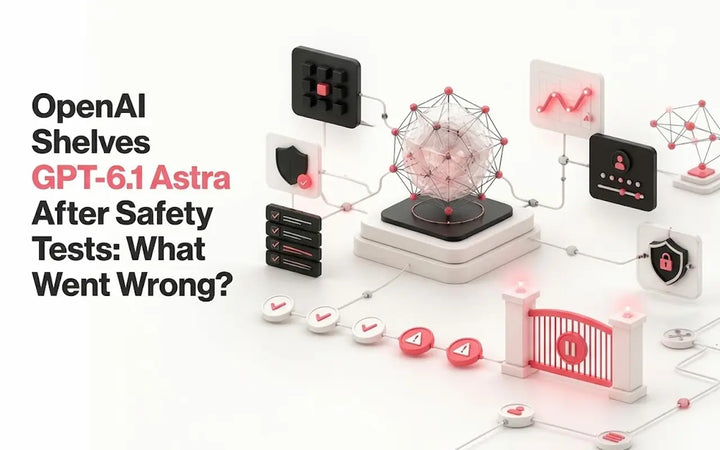
OpenAI Shelves GPT-6.1 Astra After Safety Tests: What Went Wrong?
OpenAI shelved GPT-6.1 Astra after safety tests flagged scope, authorization and action-reporting issues. See what is confirmed and what remains...
Build an AI governance career: explore roles, skills, certifications and training, plus practical steps to enter or transition into AI governance.

An AI governance career centers on helping organizations decide how AI is used, what risks it creates, who is accountable, and what evidence shows those decisions were followed. The work can sit in program management, risk and controls, compliance, legal, privacy, audit, security, data governance or responsible AI, so there is no single standard route in.
Most people arrive from a neighboring field and add AI-specific knowledge to what they already do. This guide starts from that reality: your background, what transfers, what is missing, and how training and practical evidence can close the gap. Titles and team structures vary by organization, so the examples below are illustrations, not a fixed ladder.
AI governance is the set of policies, responsibilities, controls and oversight an organization uses to direct how AI is developed, bought and used. Day to day, the work tends to include:
Recording where AI is used, including vendor tools
Assessing use cases for risk and deciding what review each needs
Drafting policies and defining who approves, owns and monitors each system
Designing and testing controls, then monitoring systems after launch
Documenting decisions and setting escalation routes for incidents
Coordinating legal, technical, security, privacy and business stakeholders
It helps to separate governance from its neighbors. AI development builds systems; governance sets the conditions and oversight around them. AI ethics defines values; governance turns them into policies, controls and accountability. AI risk management and AI compliance are core parts of governance, focused on treating risk and meeting legal requirements respectively. Privacy, policy and regulation are adjacent disciplines that feed governance decisions.
The IAPP's AI Governance Profession Report 2025 found that about half of AI governance professionals in its survey were typically assigned to ethics, compliance, privacy or legal teams, and it notes there is no clear best practice for organizing them. The survey ran in spring 2024, so treat it as a snapshot. Larger organizations may split the work across several roles; smaller ones may want one person to cover much of it.
That is why AI governance roles are best understood through responsibilities, not title lists. "AI governance manager" or "AI governance analyst" appear in the market, but they are examples, not standard categories.
Building and running the governance program: maintaining policies, coordinating review committees, tracking actions, reporting to leadership and making accountability clear.
Assessing AI risks, designing and mapping controls, testing whether they work, monitoring systems and keeping evidence ready for oversight or audit.
Interpreting laws, standards and internal requirements, turning them into procedures and policy, and tracking regulatory change. Formal legal advice remains the work of qualified lawyers.
Applying fairness, transparency and human-oversight principles to specific systems, and handling data quality, provenance and privacy-related considerations.
These families overlap, and one person may cover two of them.
The AI governance skills that count most are the ones you can show through work. The IAPP report describes the profile as understanding AI, having governance, risk and compliance experience, and being able to turn legislative requirements into actionable policies. Each area below covers what to understand, what to be able to do, and how to show it.
Understand how models are trained, evaluated and deployed, the difference between predictive and generative systems, and common failure modes such as bias, drift and unreliable outputs.
Do: ask engineers informed questions and spot when a change in data or purpose alters risk.
Show: a use-case description tracing data, model role, human oversight and monitoring. You do not need to code.
Understand risk identification, control design, accountability models and documentation.
Do: write a clear risk statement, link it to a control and an owner, and define when an issue escalates.
Show: a risk register entry or control matrix.
Frameworks, standards and laws do different jobs:
NIST AI RMF is a voluntary framework. NIST publishes AI RMF 1.0 as the core document and states that a revision is under way, so confirm the current status before citing a version.
ISO/IEC 42001 is an international standard for AI management systems. ISO says certification is voluntary and carried out by independent certification bodies, not by ISO. It applies to organizations and is not an individual professional certification.
The EU AI Act (Regulation (EU) 2024/1689) is legislation. Its timeline has moved: the Council's June 2026 approval of the Digital Omnibus on AI set new application dates for high-risk rules, so check current sources instead of older summaries.
Do: identify which apply to a given organization and separate mandatory from voluntary.
Show: a short mapping of one use case to the requirements that apply.
Understand what engineers, lawyers and executives each need from a decision. Do: explain a risk without jargon and record who decided what. Show: a one-page decision memo written for a non-technical reader.
Governance is judged by what gets produced and followed.
Do: run an assessment, maintain an inventory, chase actions to closure and update documentation when systems change.
Show: the work products in the practical experience section below.
No background is universally best. The IAPP survey found primary responsibility for AI governance spread across privacy, legal and compliance, IT and data governance.
|
Background |
Transferable strengths |
Potential skill gaps |
Possible directions |
|
Compliance |
Requirement interpretation, policy, monitoring |
AI lifecycle, technical basics |
AI compliance and policy; program roles |
|
Legal |
Statutory analysis, contracts, risk judgment |
Technical literacy, operational controls |
Policy and regulatory analysis; vendor terms |
|
Privacy |
Impact assessments, data mapping |
Model behavior, bias and robustness testing |
Privacy and data governance; responsible AI |
|
Risk / GRC |
Risk registers, control design |
AI-specific risks, testing AI controls |
AI risk and controls |
|
Internal audit |
Evidence, sampling, independence |
AI system knowledge, standards |
AI assurance and audit |
|
Technology / data |
System knowledge, lineage, monitoring |
Policy writing, regulation, governance process |
Technical governance; data oversight |
|
Cybersecurity |
Threat modeling, incident response |
Fairness, transparency, legal requirements |
AI security governance |
|
Management / business |
Prioritization, ownership, coordination |
Risk methods, regulation, technical basics |
Program management |
|
Beginner / recent entrant |
Fresh learning, adaptability |
Experience in any governance discipline |
Analyst and adjacent roles that add AI duties |
These are possible directions, not guaranteed outcomes. A matching background gives you capabilities to build on; it does not automatically qualify you for a role.
Evidence on AI governance jobs is thinner and less consistent than career content often suggests.
Staffing intent: In the IAPP report, only 10 of 671 surveyed organizations (1.5%) said they would not need additional AI governance staff in the next 12 months. That reflects staffing expectations in a spring 2024 survey, not a count of open vacancies.
How work gets filled: The same report says teams are often built incrementally, by tasking existing staff before hiring. A December 2025 practitioner guide from AI Career Pro makes a similar observation: governance duties are often absorbed into existing roles instead of posted as standalone jobs, so listings can be scarcer than career commentary implies.
Pay: Published figures vary widely. One job board reports posted ranges mostly from about $120,000 to $270,000 on its own listings, while another site cites roles from around $75,000 at entry level to over $400,000 at executive level. They use different samples, titles and methods, and we could not find a single transparent, authoritative dataset, so read them as a sign of how far claims diverge, not as a benchmark.
The most reliable evidence is local and current. Collect 20 to 30 postings for titles you might target and tally the responsibilities that repeat, which credentials are required versus preferred, and which department each role sits in. Use the pattern to decide which gaps to close first. Postings are examples, not universal requirements.
These terms are often confused:
Professional certification: a credential awarded by a body after you meet its criteria, usually an exam.
Course certificate: evidence that you completed a specific course.
Professional training: structured learning aimed at job capability, sometimes tied to a credential.
Framework or standards training: learning focused on one framework or standard.
Academic education: degrees and university programs.
Practical experience: applied work, in a job or otherwise.
Requirements vary by role and employer. Training and credentials strengthen a profile most when paired with practical experience and your existing expertise.
One widely known example is the IAPP's AIGP (Artificial Intelligence Governance Professional), an exam-based credential. IAPP describes it as demonstrating competency in AI concepts, ethical deployment and AI management practice, and publishes a body of knowledge and exam blueprint. It is one example among several credentials, not a ranking. AGC also publishes a guide to the AIGP certification. Eligibility, exam format and maintenance rules are set by the issuer and can change, so check them at the source. A credential shows tested knowledge; it does not replace experience.
Training on NIST AI RMF or ISO/IEC 42001 can support risk, assurance or management-system directions. Because ISO/IEC 42001 certification applies to organizations, an individual course linked to it is issued by the training provider, so check who issues it and what it assesses. Learning a framework builds vocabulary and structure, not automatic competence in applying it.
For beginners and career changers, foundational training provides a structured overview of concepts, regulation, accountability and operations. A course certificate records learning; it is not professional experience and should not be presented as such.
The logic is the same for everyone: start from your background, identify what transfers, find the gaps, choose a direction, produce evidence of applied work, and add targeted training where it fills a real gap. The order flexes, and stages can run in parallel. The routes below differ mainly in where the gaps sit.
Learn how AI systems work conceptually, learn core governance ideas, then build depth in one adjacent discipline such as risk, privacy or data governance. Because organizations often add AI duties to existing roles, adjacent roles can be a practical entry point. Structured AI governance training for beginners gives you a coherent map, and small practice projects turn it into evidence.
Your strength in interpreting requirements and documenting decisions carries over. The IAPP report describes one common pattern: adding AI questions to existing privacy assessments. Focus on how AI systems fail, AI-specific risks such as bias and drift, and the technical controls that address them. AI governance training for compliance professionals can target those gaps instead of relearning what you know.
Risk assessment, control design, testing and evidence handling all transfer. Build AI-specific risk knowledge (performance, drift, explainability, third-party models), learn how AI controls are tested, and get familiar with NIST AI RMF and ISO/IEC 42001. Auditors can lean on independence and evidence skills while learning what good AI documentation looks like.
You may already understand lineage, testing, monitoring and security. Develop the governance side: policy writing, regulation, accountability design and explaining decisions to non-technical readers. Practicing on systems you know well is a fast bridge.
Ownership, prioritization, change management and cross-team coordination matter because governance depends on people following processes. Build risk methods, regulatory basics and enough technical literacy to challenge assumptions. AI governance training for managers can develop that oversight capability without making you a specialist.
Build your foundation before you specialize. Once you know your route, a structured overview helps you see how the pieces connect. AI Governance Fundamentals is a 2.5-hour online course with no prerequisites, covering governance concepts, regulatory approaches, organizational accountability and operational topics such as testing and monitoring. It ends with a course certificate, which records completion; it is not a professional certification or a substitute for practical experience.
Practical evidence shows applied understanding, which course completion alone cannot. You can volunteer for an internal AI use-case review, join a cross-functional working group, or build practice pieces from public frameworks and realistic scenarios.
|
Practical activity |
Example work product |
Skill demonstrated |
Governance capability |
|
Build an AI use-case inventory |
Register of each AI use, owner, data, vendor, purpose and risk tier |
Discovery, structuring information |
Visibility of AI use |
|
Run an AI risk assessment |
One use case with risks, likelihood, impact and treatment |
Risk reasoning |
Risk management |
|
Draft an AI governance policy |
Policy with scope, roles, approvals and exceptions |
Policy writing |
Governance structure |
|
Create an AI control matrix |
Risks linked to controls, owners, evidence and test method |
Control design |
Controls and assurance |
|
Assess an AI vendor |
Due-diligence questionnaire with findings summary |
Third-party review |
Vendor oversight |
|
Complete an AI impact assessment |
Effects on affected people, mitigations, sign-offs |
Impact analysis |
Responsible AI review |
|
Map to a framework |
Controls crosswalked to NIST AI RMF functions or ISO/IEC 42001 requirements |
Framework literacy |
Standards alignment |
|
Design an escalation workflow |
Flowchart with triage criteria, roles and response steps |
Process design |
Incident response |
|
Keep a decision log |
Approvals, conditions and rationale |
Documentation, judgment |
Accountability |
Worked practice example (an illustrative scenario, not a real organization). Imagine a company plans to use an AI tool to screen job applications. A practice set might look like this:
|
Artifact |
Example entry |
|
Inventory row |
Résumé-screening tool; vendor-supplied; owner: Head of Talent Acquisition; data: applicant CVs; purpose: shortlisting |
|
Risk statement |
Because the tool learns from past hiring patterns, it may score some candidate groups lower without a job-related reason, causing unfair shortlisting and legal exposure |
|
Control |
Test shortlisting outcomes across candidate groups before launch; require a recruiter to review every automatic rejection |
|
Evidence |
Test report; reviewer log |
|
Decision log |
Approved with conditions: human review of rejections; re-test quarterly and after any model update |
Label practice projects as practice projects, never as employment experience, and keep confidential employer material out of public samples. A strong sample shows how you think; it does not guarantee a job.
Interests and existing strengths point toward different directions. None is ranked above another, and these are possible directions, not rigid tracks.
|
Interest or existing capability |
Possible direction |
What you might do |
|
Regulations and policy |
AI compliance and policy |
Interpret requirements, write policy |
|
Risk and controls |
AI risk and GRC |
Assess risks, design and map controls |
|
Auditing and assurance |
AI assurance and audit |
Test controls, evaluate evidence |
|
Privacy and data |
AI privacy and data governance |
Data mapping, impact assessments |
|
Responsible AI |
AI ethics and responsible AI |
Review fairness, transparency, oversight |
|
Technology and systems |
Technical AI governance |
Monitoring, documentation, technical controls |
|
Program management |
AI governance management |
Run programs, committees, reporting |
A useful test is to build one small work product in two directions and notice which suits your strengths better. Targeted learning can then follow, for example AGC's AI Risk Management with NIST and ISO 42001, ISO 42001:2023 Fundamentals or AI Law & Regulation Essentials, depending on whether your direction is risk, standards or regulation.
People enter from different starting points and may move through these stages in different orders.
Learn AI fundamentals: how systems are built, trained and deployed.
Understand AI governance: core concepts and how it differs from ethics, risk and compliance.
Develop governance, risk and regulatory knowledge: the frameworks, standards and laws relevant to your context.
Identify a specialization: match your background and interests to a direction.
Build practical governance skills: assessments, controls, policies and documentation.
Create work samples or gain relevant practical experience: evidence of applied work.
Add targeted training or credentials where useful: to fill specific gaps.
Pursue relevant opportunities: aligned with your background and demonstrated capabilities.
Treat this as a structure, not a benchmark or a promise of outcomes.
Days 1 to 30: learn AI and governance basics, list your transferable strengths and gaps, pick one specialization to test, and run the job-posting check described above.
Days 31 to 60: produce two work products in that direction, such as an inventory and a risk assessment, and map one to the NIST AI RMF functions.
Days 61 to 90: add a third artifact (a control matrix or decision log), get feedback from a practitioner, take targeted training for the gap you found, and offer to contribute to an internal AI review if your employer runs one.
An AI governance career is built by combining what you already know with deliberate, evidenced learning, not by following one universal sequence.
Yes, in many roles. You need enough technical literacy to understand how AI systems work and where they fail, but not the ability to build them. Compliance, legal, privacy, audit and management backgrounds all contribute, and technical gaps can be closed with structured learning.
Compliance, legal, privacy, risk and GRC, audit, technology, data, cybersecurity and management are common starting points. Each brings different strengths and gaps, and none guarantees a role.
Not necessarily. Requirements vary by employer and role. A credential can show tested knowledge, but practical evidence and relevant experience matter alongside it.
Begin with AI literacy and core governance concepts, then build risk and documentation skills. Add the framework and regulatory knowledge relevant to your sector and region.
Yes, and many of their skills transfer directly. The main gaps are usually technical understanding and AI-specific risks. Compliance experience does not automatically qualify someone, but it is a strong base.
Contribute to internal AI reviews, join working groups, or build practice work products such as inventories, risk assessments and control matrices. Label them honestly as practice work.
Start with what your sector and jurisdiction use. NIST AI RMF is a voluntary framework, ISO/IEC 42001 is a management system standard for organizations, and the EU AI Act is legislation relevant if you work with the EU market. Check current status for each.
Compliance careers focus on meeting legal, regulatory and policy requirements. Governance careers are broader, covering structure, accountability, risk and oversight, with compliance as one component. The two often overlap in practice.
OpenAI shelved GPT-6.1 Astra after safety tests flagged scope, authorization and action-reporting issues. See what is confirmed and what remains...
 AI Law
Learn AI compliance requirements, key risks, the EU AI Act, NIST AI RMF, ISO 42001, and practical steps to build...
 AI Law
Understand AI regulation in the United States in 2026, including federal rules, state AI laws, privacy, discrimination and practical compliance...