
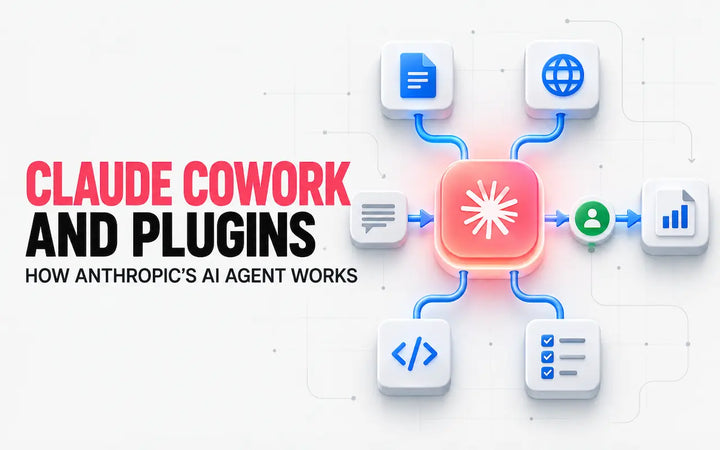
Claude Cowork and Plugins: How Anthropic’s AI Agent Works
Learn how Claude Cowork, plugins and agentic workflows work for business, including practical use cases, security risks and responsible AI...

Beginners often encounter technical language, ethical principles, regulations and management frameworks at the same time. The challenge is learning them in the right order.
AI governance is the system of responsibilities, policies, processes and controls used to direct and oversee how an organization develops, buys and uses AI.
AI Governance Training explains how organizations make accountable decisions across the AI lifecycle. It connects responsible AI principles with risk assessment, policies, oversight and monitoring. Start with basic AI concepts, then study principles, risks, governance instruments and organizational controls.
Start with AI literacy before detailed regulations.
Treat ethics, compliance and risk as parts of governance.
Distinguish NIST, ISO, OECD and the EU AI Act.
Choose training connected to organizational decisions.
Build role-specific expertise after the fundamentals.
Produce a simple work sample at each stage.
AI Governance Training teaches people how organizations assign responsibility for AI, identify and manage risks, establish policies, oversee systems and document important decisions. It usually covers responsible AI, ethics, compliance awareness, risk management, data governance, human oversight and lifecycle monitoring.
It differs from technical AI training, which may focus on programming, data science or model development. Governance learners need enough technical literacy to understand a system, recognize limitations and identify questions requiring specialist input. They do not necessarily need to build the system.
AI ethics examines values such as fairness, human autonomy and potential harm. Governance turns those concerns into responsibilities, controls and decision authority. AI compliance focuses on applicable legal, regulatory and contractual requirements. AI risk management identifies, assesses, treats and monitors risks. Both are important components of broader governance.
It can benefit compliance, legal, risk, privacy, audit, security, data, product and management professionals. The required depth depends on the role.
Beginners should progress from AI literacy to organizational oversight, avoiding memorized terminology without context.
Start with a high-level understanding of AI, machine learning and generative AI. Learn common use cases and the main lifecycle stages: planning, data preparation, development or acquisition, testing, deployment, monitoring and retirement.
Consider a hypothetical company adopting a generative AI assistant. It must consider permitted data, output review, approval, incident reporting and monitoring, even if it did not build the model.
Beginner outcome: Create a one-page glossary explaining common AI terms and lifecycle stages in plain language.
Next, study accountability, transparency, fairness, privacy, safety, security and human oversight. There is no single universally mandated list of AI governance principles, and their wording and legal significance vary by source and context.
The OECD AI Principles, first adopted in 2019 and updated in May 2024, provide recommendations for trustworthy AI and effective public policy. They are principles, not legislation.
Connect each principle to decisions. Fairness can affect data selection and outcome testing. Transparency can shape notices and documentation. Effective human oversight requires a reviewer with adequate information, competence and authority to intervene.
Beginner outcome: Match each principle to one organizational decision, control or item of evidence.
AI risk management involves identifying possible harm, assessing its likelihood and impact, selecting controls, monitoring results and reviewing the system when conditions change.
Risks may include inaccurate outputs, unfair outcomes, privacy loss, security weaknesses, unsafe decisions or excessive reliance on automation. Their significance depends on the context.
The NIST AI Risk Management Framework is voluntary. Its Core organizes risk activities through four functions: Govern, Map, Measure and Manage. These functions are not laws or mandatory regulatory steps. The AI RMF Playbook provides suggested actions rather than a universal checklist.
NIST states that AI RMF 1.0 is being revised. Learners should therefore consult current NIST materials rather than relying on an undated summary.
Beginner outcome: Complete a simple risk assessment for a hypothetical AI use case, identifying its purpose, affected people, possible harms, controls and monitoring needs.
Beginners should distinguish different governance instruments before trying to apply them:
Laws and regulations create legally enforceable requirements within their scope.
Standards contain agreed requirements or guidance and may be adopted voluntarily, contractually or through other obligations.
Frameworks organize activities, outcomes or risk-management practices.
Principles express values and high-level expectations.
The EU AI Act is an EU regulation with a phased application timetable. It entered into force on 1 August 2024, and its main application date was 2 August 2026, although different provisions follow different dates. Because the timetable has been amended, check the Commission's current guidance and the official legal text on EUR-Lex before making compliance decisions.
ISO/IEC 42001:2023 is an international standard specifying requirements and providing guidance for establishing, implementing, maintaining and continually improving an AI management system. It is not legislation.
NIST AI RMF is a voluntary risk-management framework. The OECD AI Principles provide responsible AI principles and policy recommendations. Understanding these differences matters more for a beginner than memorizing document titles.
Beginner outcome: Build a one-page comparison that labels each instrument as a law, standard, framework or set of principles.
Finally, learn why organizations maintain AI inventories, assign system owners, establish acceptable-use rules, assess proposed uses and document approvals. Also study committees, escalation routes, monitoring, incident reporting and periodic review. A policy establishes expectations, but effective governance also requires owners, processes, evidence and authority.
Beginner outcome: Draft a simple responsibility map showing who proposes, reviews, approves, monitors and, when necessary, suspends an AI use case.
The most useful AI governance skills depend on the role. A strong foundation includes AI literacy, risk assessment, regulatory awareness, policy interpretation, data awareness, documentation, communication, stakeholder management and ethical reasoning.
|
Professional background |
Skills to prioritize first |
|
Compliance, legal or privacy |
Regulatory interpretation, control design, documentation and escalation |
|
Risk or internal audit |
Risk assessment, evidence evaluation, monitoring and assurance |
|
Management or operations |
Accountability, vendor oversight, approval decisions and communication |
|
Data or technology |
Lifecycle governance, testing, data governance and cross-functional communication |
|
Ethics or public policy |
Impact analysis, stakeholder reasoning, risk controls and implementation |
Beginners need a shared foundation followed by skills that match their responsibilities.
Beginners should understand the purpose and status of four major instruments before attempting detailed implementation.
|
Instrument |
Type |
What beginners should understand |
Main relevance |
|
NIST AI RMF |
Voluntary framework |
Purpose and Govern, Map, Measure and Manage functions |
AI risk management |
|
ISO/IEC 42001 |
International standard |
Purpose and basic AI management system concept |
Organizational AI management |
|
OECD AI Principles |
Intergovernmental principles |
Responsible AI themes and policy recommendations |
Trustworthy AI |
|
EU AI Act |
EU regulation |
Risk-based structure, organizational roles and phased application |
AI regulation |
These instruments can complement one another, but they are not interchangeable. An organization might use NIST AI RMF for risk activities, ISO/IEC 42001 for a management system, OECD principles for responsible AI and the EU AI Act to identify applicable legal obligations.
Build a structured foundation in AI governance
The AI Governance Fundamentals course introduces responsible AI, risk management, regulation, organizational accountability, data governance and operational oversight. It is a 2.5-hour online course in English, includes a certificate upon successful completion and requires no specific prior qualifications.
Training should reflect the learner's decisions and risks.
AI governance training for compliance professionals should connect regulatory interpretation with AI-specific risks, controls, policies, evidence and accountability.
They may help identify applicable requirements, coordinate assessments, review policies, maintain evidence and monitor controls. They should also know when legal, privacy, security or technical expertise is needed.
AI governance training for managers should focus on decision-making, responsibility, vendor oversight and risk awareness.
A manager evaluating a hypothetical recruitment tool should ask who validates performance, investigates unfair outcomes and can pause its use. The manager should understand the evidence needed for an accountable decision.
Coding is not necessarily the starting point for non-technical learners. They still need enough AI literacy to question claims and work with technical specialists. Specialized assurance roles may later require statistics, testing methods or programming.
Choose training by examining its curriculum, level and learning outcomes, not simply whether it uses the word certification.
A suitable course should cover AI fundamentals, responsible AI, risk management, organizational governance and regulatory concepts. It should distinguish legal requirements from voluntary guidance.
Before enrolling, ask:
Is the course explicitly suitable for beginners?
Does it separate governance, ethics, risk and compliance?
Does it cover the AI lifecycle and organizational accountability?
Are laws distinguished from standards, frameworks and principles?
Are the learning outcomes specific and understandable?
Does the provider explain assessments and completion requirements?
Does the certificate accurately describe what was learned or assessed?
Is the curriculum dated or reviewed as the field changes?
A completion certificate can document learning, but it is not automatically a professional licence, employment credential or guarantee of competence.
|
Beginner training |
Advanced training |
|
Foundational concepts |
Specialized subjects |
|
AI literacy |
Deeper technical or governance knowledge |
|
Core principles |
Advanced implementation |
|
Introductory framework knowledge |
Detailed framework application |
|
Basic governance concepts |
Program-level governance |
Neither level is universally better. The right choice depends on current knowledge, responsibilities and learning goals.
Foundational training can develop knowledge of AI governance language, responsibilities and methods.
Relevant work may sit within responsible AI, risk, compliance, policy, privacy, audit, security or data governance. Existing experience in controls, data, law, technology or management can complement governance knowledge.
For someone exploring an AI governance career, training is a starting point, not a guarantee of employment. A useful portfolio sample could be a labelled hypothetical assessment containing a use-case description, stakeholder map, initial risks, governance roles and monitoring questions.

Understand common capabilities, limitations, uses and lifecycle stages. Create a concise terminology and lifecycle sheet.
Study core principles and match each one to an organizational decision or control.
Identify stakeholders, potential harms, controls and monitoring needs for one hypothetical use case.
Compare NIST AI RMF, ISO/IEC 42001, OECD AI Principles and the EU AI Act by type and purpose. Use the European Commission's AI Act guidance for current EU developments.
Create a responsibility map covering proposal, review, approval, monitoring, escalation and suspension.
Choose the next subject according to your role. Risk professionals can deepen NIST AI RMF knowledge. Assurance professionals can study ISO/IEC 42001 implementation. Compliance professionals can develop jurisdiction-specific knowledge. Managers can focus on vendor oversight, while technical professionals can study testing, monitoring, security and data governance.
AI ethics, compliance and implementation should build on a clear understanding of systems, risks and responsibility.
Move from scattered reading to structured learning
AI Governance Fundamentals offers a defined starting point for learning responsible AI, risk, regulation, accountability and lifecycle oversight. The course is designed for individuals and organizational teams seeking foundational AI Governance Training without specific prior qualifications.
Learn how Claude Cowork, plugins and agentic workflows work for business, including practical use cases, security risks and responsible AI...

Artificial intelligence rarely belongs to one department. A business team may propose a use case, engineers may build or configure...