
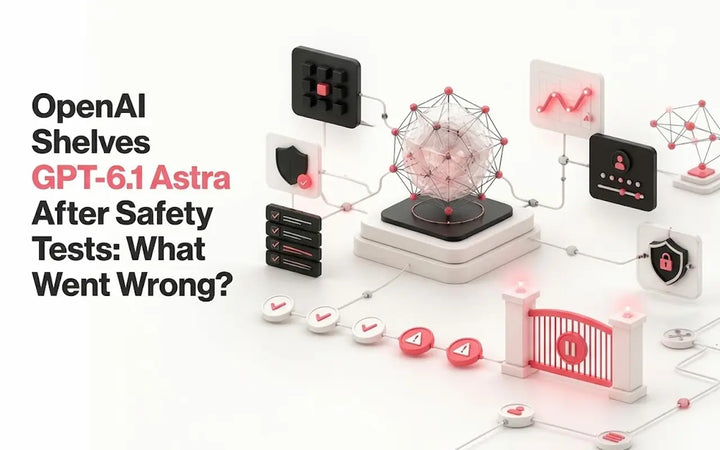
OpenAI Shelves GPT-6.1 Astra After Safety Tests: What Went Wrong?
OpenAI shelved GPT-6.1 Astra after safety tests flagged scope, authorization and action-reporting issues. See what is confirmed and what remains...

Artificial intelligence is spreading across workplaces faster than many organizations can create the rules needed to control it.
The Artificial Intelligence Governance Professional certification, known as AIGP, is a professional credential for people who want to understand how AI systems should be governed responsibly throughout their lifecycle.
As businesses adopt AI for hiring, customer service, fraud detection, decision-making, and content creation, the risks become harder to ignore. Poorly governed systems can lead to biased outcomes, privacy violations, security failures, inaccurate decisions, and regulatory problems.
This creates a growing need for professionals who can connect AI technology with legal requirements, ethical principles, risk management, human oversight, and organizational accountability.
The AIGP certification provides a structured introduction to these responsibilities. It covers the foundations of AI governance, relevant laws and standards, responsible AI development, risk assessment, documentation, deployment controls, and ongoing monitoring.
AIGP stands for Artificial Intelligence Governance Professional.
It is a professional certification offered by the International Association of Privacy Professionals, or IAPP. The credential is intended to demonstrate competency in AI development governance, ethical deployment, and the ongoing management of AI systems to support safety and trust.
The certification is not mainly about programming an AI model. It focuses on the decisions, controls, responsibilities, policies, assessments, and monitoring processes that should surround AI.
An AIGP-certified professional should understand questions such as:
These questions form the foundation of AI governance.
AI governance is the system of rules, responsibilities, policies, controls, and review processes used to direct how an organization develops and uses artificial intelligence.
Consider a company that introduces an AI system to screen job applicants. The tool may appear efficient, but it could also learn patterns from historically biased recruitment data. It might reject qualified candidates, process personal information unlawfully, or generate decisions that recruiters cannot explain.
AI governance determines what should happen before, during, and after that system is introduced.
Before deployment, the organization might conduct an impact assessment, examine the training data, test for discrimination, define human-review requirements, and document why the system is needed.
During use, it might monitor accuracy, collect user feedback, maintain audit records, and provide candidates with relevant information.
After a failure, it should have a process for investigating the incident, correcting the system, communicating with affected stakeholders, and deciding whether the system should be restricted or deactivated.
The AIGP curriculum prepares professionals to understand and coordinate these responsibilities across an organization.
Build Your AI Governance Knowledge
AI Governance: The Fundamentals of AI Governance
Develop a clear understanding of responsible AI, governance principles, risk management, accountability, and organizational controls.
Enrol NowThe credential is designed to show that a professional understands four broad areas.
First, the person understands basic AI concepts, responsible AI principles, and the reasons AI systems require governance.
Second, the person understands how existing laws, AI-specific laws, standards, and frameworks can apply to AI.
Third, the person understands governance during the development of an AI system, including design, data collection, testing, documentation, release, and monitoring.
Fourth, the person understands governance when an organization selects, deploys, purchases, or uses an AI system.
The credential does not prove that someone is an expert software engineer, data scientist, lawyer, auditor, and risk manager at the same time. Instead, it demonstrates a cross-functional understanding of how these disciplines work together around AI.
As of July 2026, the current AIGP Body of Knowledge is version 2.1, effective from 2 February 2026. The IAPP states that the Body of Knowledge is reviewed regularly and that exam questions are based on its listed competencies and performance indicators.
The exam is divided into four domains.
|
AIGP exam domain |
Question range |
What it means in simple terms |
|
Foundations of AI governance |
16 to 20 |
Understanding AI risks, responsible AI principles, governance roles, policies, and organizational responsibilities |
|
Laws, standards, and frameworks |
19 to 23 |
Understanding how privacy law, discrimination law, consumer protection, AI-specific regulation, and major frameworks apply |
|
Governing AI development |
21 to 25 |
Managing risk while designing, training, testing, releasing, and maintaining AI systems |
|
Governing AI deployment and use |
21 to 25 |
Assessing, purchasing, deploying, monitoring, and sometimes deactivating AI systems |
This domain explains what AI is and why it requires governance.
Candidates need to understand commonly accepted AI concepts, different types of AI, and characteristics such as opacity, autonomy, speed, scale, data dependency, and probabilistic outputs.
It also covers responsible AI principles such as fairness, privacy, security, transparency, explainability, reliability, accountability, safety, and human-centricity.
The organizational side is equally important. Candidates must understand stakeholder responsibilities, cross-functional governance, employee awareness, third-party risk, acceptable-use rules, and policies covering the AI lifecycle.
This domain examines how legal and governance requirements apply to AI.
It covers privacy concepts including transparency, lawful basis, purpose limitation, data minimization, privacy by design, sensitive data, automated decision-making, impact assessments, third-party processing, international data transfers, and breach management.
It also includes intellectual property, nondiscrimination, consumer protection, and product liability.
Candidates must understand the main elements of AI-specific regulation, including risk classification, documentation, human oversight, transparency, quality management, general-purpose AI obligations, enforcement, and the responsibilities of different participants in an AI supply chain.
The current Body of Knowledge also identifies major resources such as the OECD AI principles, the NIST AI Risk Management Framework, ISO/IEC 22989, ISO/IEC 42001, and ISO/IEC 42005.
This domain focuses on organizations that design, build, train, test, release, or maintain AI systems.
Candidates should understand how to define the business use case, identify affected stakeholders, perform an AI impact assessment, select suitable models and metrics, establish human oversight, and document important development decisions.
Data governance is a major part of this domain. Candidates need to understand data quality, quantity, integrity, lawful collection, fitness for purpose, data lineage, and provenance.
The domain also covers testing for performance, bias, security, interpretability, reliability, and other risks. After release, governance continues through monitoring, audits, red teaming, threat modelling, incident management, maintenance, retraining, and public disclosures where required.
Not every organization develops its own AI. Many organizations purchase tools, access AI through cloud services, use open-source models, or integrate third-party systems into existing workflows.
This domain covers the governance responsibilities of those organizations.
Candidates should understand different model types and deployment methods, including traditional and generative AI, proprietary and open-source models, cloud and on-premise deployment, retrieval-augmented generation, fine-tuning, and agentic architectures.
They also need to evaluate vendor agreements, licensing terms, business requirements, data availability, workforce readiness, ethical concerns, and the risks associated with deploying an AI system.
Once a system is operational, the organization should maintain monitoring, audits, testing, documentation, incident controls, communication plans, and procedures for restricting or deactivating the system when necessary.
The current exam contains 100 questions. Candidates receive 2.75 hours with a 15-minute break. Questions are multiple choice, and some may use workplace scenarios or require candidates to select a specified number of correct answers.
|
Exam detail |
Current information |
|
Number of questions |
100 |
|
Exam time |
2.75 hours with a 15-minute break |
|
Member price |
$649 |
|
Nonmember price |
$799 |
|
Exam provider |
Pearson VUE |
|
Delivery options |
Testing centre or remotely through OnVUE |
|
Time allowed after purchase |
One year |
|
Passing score |
300 on the IAPP reporting scale |
The IAPP store currently lists the exam at $649 for members and $799 for nonmembers. It can be completed remotely or at a Pearson VUE testing centre, and it must be taken within one year of purchase. Prices and policies may change, so candidates should confirm them before registering.
Computer-based exam results are normally provided immediately after completion. The passing score is reported as 300 on a scale ranging from 100 to 500. A score of 300 does not mean that the candidate answered exactly 60% of the questions correctly.
AIGP can be relevant to professionals who influence how AI is approved, purchased, developed, managed, or monitored.
Compliance and risk professionals can use the curriculum to understand AI-specific risks, controls, assessments, documentation, and regulatory responsibilities.
Privacy and data protection professionals can strengthen their understanding of how data protection principles apply to training data, automated decisions, profiling, biometric information, third-party systems, and AI monitoring.
Legal and policy professionals can develop a more complete view of the AI lifecycle instead of examining legislation separately from technical and operational decisions.
Internal auditors and assurance professionals can better understand the evidence, controls, testing records, governance structures, and accountability mechanisms expected around AI systems.
AI product managers and technology leaders can learn how governance requirements affect product design, model selection, data use, testing, deployment, and monitoring.
Business leaders and consultants can build enough AI governance literacy to ask stronger questions and coordinate legal, technical, ethical, security, and business stakeholders.
The IAPP describes AIGP as relevant to professionals across industries who need to understand and execute responsible AI governance.
You do not need to become a programmer to understand the AIGP material, but the certification should not be treated as a purely legal or policy exam.
Candidates need sufficient technical literacy to understand model types, training and testing, deployment options, data lineage, monitoring, drift, security testing, red teaming, interpretability, and the differences between traditional, generative, and agentic AI.
A beginner can study these topics without learning advanced mathematics or writing production code. However, memorizing legal definitions alone is unlikely to provide enough preparation because the exam includes application and scenario-based questions. This conclusion follows from the current Body of Knowledge, which requires candidates to understand both governance principles and operational AI lifecycle activities.
No paid training product is required.
The IAPP recommends at least 30 hours of study, beginning with its free Body of Knowledge, exam blueprint, study guide, terminology resources, and candidate information.
The organization also states that no paid resource is required to pass. Its courses and textbooks are optional learning tools, and completing an official training course does not guarantee a passing result.
This distinction is important:
An AIGP training certificate of attendance shows that someone completed a training programme.
The AIGP professional certification requires the person to pass the certification exam and satisfy the applicable certification maintenance requirements.
The official online training currently costs $1,195, while the optional digital practice exam costs $60. These products are separate from the certification examination.
Begin with the current Body of Knowledge rather than random articles or older study notes. AI regulation and governance standards change quickly, and previous versions may not match the present exam.
Turn every performance indicator into a study question. For instance, do not simply memorize the term “human oversight.” Ask when human oversight is needed, who should perform it, what authority that person needs, and how the organization should document the process.
Study the four domains together. Legal obligations affect development decisions. Data governance affects model performance. Vendor contracts affect deployment risk. Monitoring affects incident response. The exam tests these connections rather than treating each topic as completely separate.
Use scenarios to practise decision-making. Consider an AI hiring system, fraud detection model, customer-service chatbot, medical-support tool, or employee-monitoring system. Identify the stakeholders, risks, applicable rules, necessary documentation, testing requirements, monitoring controls, and possible reasons to stop using the system.
Finally, use practice questions to identify weak areas, but do not rely on memorizing question patterns. The IAPP’s digital practice exam contains 100 questions with explanations and is intended to help candidates become familiar with the style and identify areas requiring further study.
The AIGP certification term lasts two years, beginning the day after the candidate passes the exam.
To maintain the certification, holders must submit evidence of 20 continuing education credits related to the AIGP Body of Knowledge and meet the certification maintenance fee requirement.
For IAPP members, the maintenance fee is covered through membership. The current AIGP exam page states that the initial maintenance fee is included in the nonmember exam price, while a $250 maintenance fee is required for nonmembers at recertification.
Continuing education matters because the AI governance field changes rapidly. New regulations, standards, model capabilities, risks, and organizational practices may emerge during a two-year certification term.
AIGP may be valuable when your work already involves AI risk, compliance, privacy, legal advice, auditing, product governance, data governance, or technology oversight.
It offers a structured knowledge base and a recognized way to demonstrate that you understand AI governance across the full lifecycle.
However, the certification should not be viewed as a guaranteed route to a job, promotion, or salary increase. Employers may also look for experience in policy development, impact assessments, audit, privacy, security, risk management, procurement, model governance, or AI product work.
For a complete beginner, the strongest value may come from using AIGP study as a roadmap. It introduces the language, frameworks, responsibilities, and lifecycle controls needed to participate in AI governance discussions.
For an experienced professional, it can help connect existing legal, privacy, technical, or risk knowledge to the emerging AI governance profession.
The Artificial Intelligence Governance Professional certification provides a broad foundation for professionals responsible for the safe and responsible use of AI.
It covers more than AI ethics and more than regulation. Candidates must understand AI concepts, organizational responsibilities, laws, standards, risk assessments, data governance, development controls, vendor risk, deployment decisions, monitoring, incidents, and accountability.
AIGP is particularly relevant for professionals who need to work between technical teams and business, legal, compliance, privacy, audit, or risk functions.
Beginners do not need to be AI engineers, but they must be willing to understand how AI systems work throughout their lifecycle. The certification is therefore best viewed as a cross-functional AI governance qualification rather than a purely legal or technical credential.
OpenAI shelved GPT-6.1 Astra after safety tests flagged scope, authorization and action-reporting issues. See what is confirmed and what remains...
 AI Law
Learn AI compliance requirements, key risks, the EU AI Act, NIST AI RMF, ISO 42001, and practical steps to build...
 AI Law
Understand AI regulation in the United States in 2026, including federal rules, state AI laws, privacy, discrimination and practical compliance...