
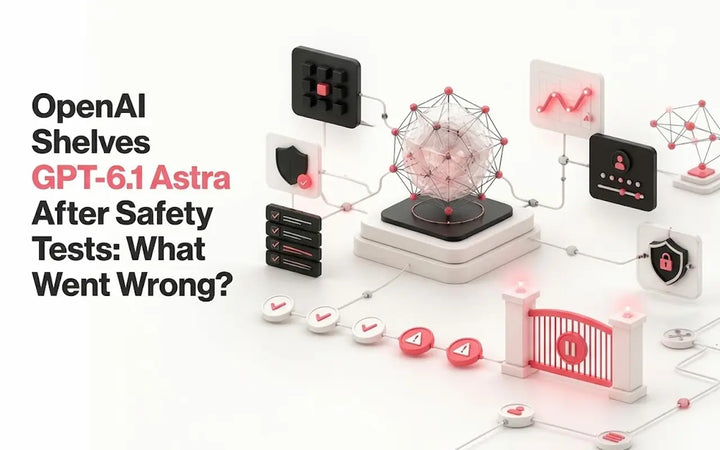
OpenAI Shelves GPT-6.1 Astra After Safety Tests: What Went Wrong?
OpenAI shelved GPT-6.1 Astra after safety tests flagged scope, authorization and action-reporting issues. See what is confirmed and what remains...

ISO 42001 risk management connects AI-related risks and opportunities with the policies, responsibilities, controls, and review processes of an Artificial Intelligence Management System. An AI policy or risk register does not create an effective management system unless it changes how an organization makes decisions.
An AIMS is the interconnected set of policies, objectives, responsibilities, and processes used to manage the responsible development, provision, or use of AI.
Within that system, risk assessment must lead to treatment and operational controls. Monitoring, incidents, and audit evidence must then feed back into new decisions. This article focuses on that risk-management component rather than every requirement of ISO/IEC 42001.
ISO/IEC 42001 embeds AI risk management within an organization-wide AIMS.
AI risks and opportunities should be addressed in context, not through an isolated risk register.
Risk assessment should lead to defined treatment decisions and appropriate controls.
AI impact assessment informs risk decisions but is not identical to risk assessment.
Controls require ownership, evidence, monitoring and review.
Continual improvement means risk decisions should evolve as systems, uses and evidence change.
ISO/IEC 42001 is an AI management system standard, not simply a risk assessment method. It helps an organization establish policies, objectives, responsibilities, and processes for governing AI, including managing risks and opportunities, operational controls, performance evaluation, and continual improvement.
The official ISO/IEC 42001:2023 standard page describes an AIMS as a structured approach to responsible AI development and use. The standard can apply to organisations of different sizes and sectors that develop, provide, or use AI-based products or services. Its management-system design can be adapted to different AI applications and organisational contexts.
Risk management therefore sits inside a wider governance structure. Leadership establishes direction and accountability, planning defines what must be addressed, operations put decisions into effect, and evaluation tests whether the system works. The broader AI risk management guide covers risk categories, methods and organisation-wide implementation beyond this AIMS-specific focus.
Risk management should operate through the AIMS rather than as a disconnected exercise. ISO's AI management systems overview explains ISO/IEC 42001 through a Plan-Do-Check-Act cycle that connects risk assessment, treatment and improvement.
Establish context, objectives, stakeholders, scope, AI uses, responsibilities and risk criteria. Identify risks and opportunities, then define treatment and evidence needs.
Implement treatment through approved processes and controls. Assign owners, provide resources and competence, and document what was done and why.
Evaluate whether controls work and whether risk, AI behaviour or context changed. Monitoring, incidents, performance measures, audits and management review provide evidence.
Correct deficiencies, revise treatment, update controls, reassess affected risks and improve the AIMS. This feedback loop prevents risk assessment from becoming a one-time approval that gradually loses relevance.

ISO/IEC 42001 connects risk management with the wider AIMS rather than treating it as an isolated assessment. In practical terms, an organisation needs to establish a coherent relationship between its context, objectives, risk decisions, operational controls, evaluation activities and improvement processes.
This means the AIMS should address:
The organisation's context and AIMS scope
Relevant interested parties and expectations
AI-related risks and opportunities
Risk-assessment and treatment processes
Responsibilities and decision authority
Operational planning and control
Performance monitoring and internal audit
Management review and corrective action
Continual improvement of the AIMS
Risk management therefore needs both governance and execution. Leadership provides direction and resources. Competent teams perform assessment and treatment. Operational owners implement controls. Monitoring, audit and management review determine whether the arrangements remain effective.
The standard addresses opportunities as well as risks. A risk may threaten responsible AI objectives, while an opportunity may improve transparency, competence, reliability, efficiency or oversight. Pursuing an opportunity can introduce new risks, so opportunity decisions should remain connected to the same governance, evidence and review mechanisms.
This article summarizes how these elements work together. Organizations seeking conformity or certification should verify detailed requirements and applicability against an authorized copy of ISO/IEC 42001 and obtain qualified advice where necessary.
This workflow translates management-system logic into practice. It is not official clause wording or a mandatory ISO/IEC 42001 sequence.
|
AIMS activity |
Main risk question |
Expected outcome |
|
Context and planning |
Which AI risks and opportunities matter here? |
Defined scope, criteria, and ownership |
|
Risk identification |
What could affect responsible AI objectives? |
Documented risk scenarios |
|
Analysis and evaluation |
How significant are the risks? |
Prioritised risk decisions |
|
Treatment |
What should be done about them? |
Risk-treatment plan |
|
Controls |
How will treatment be implemented? |
Operational safeguards and evidence |
|
Monitoring and improvement |
Are risks or controls changing? |
Reassessment and continual improvement |
Define the AI use, purpose, stakeholders, process, environment, dependencies, owner and relevant requirements. Set proportionate criteria for assessing significance and accepting residual risk.
ISO 31000:2018 provides general guidance on identifying, analysing, evaluating, treating, monitoring, and communicating risk. It can inform practice but does not replace ISO/IEC 42001.
Identify scenarios that could affect responsible AI objectives. Sources include data, model behavior, design, human interaction, third parties, privacy, security, reliability, fairness, transparency, dependencies, and misuse. Document what could happen, under which conditions, and who may be affected.
ISO/IEC 23894:2023 provides AI-specific guidance for integration into organizational activities. It can deepen AIMS risk methods, but the standards are not interchangeable.
Assess likelihood, severity, stakeholders, exposure, uncertainty, and safeguards against risk criteria. The result should support a decision, not merely a score. Keep judgement, assumptions and evidence limitations visible.
Impact severity informs risk evaluation but is not a synonym for risk. AI risk vs AI impact explains how uncertain scenarios differ from the effects that may follow.
Determine whether risk should be reduced, avoided, otherwise treated or accepted. Record the objective, risk owner, action owner, measures, evidence, expected residual risk and review conditions. Acceptance requires deliberate, documented authority.
Convert treatment into technical, organizational, procedural, human, or contractual safeguards. Define each control's purpose, owner, expected reduction, evidence, testing, and limitations. Existence does not prove effectiveness. Validation should show whether the control changes its targeted likelihood, exposure, or consequence.
Use performance data, control evidence, incidents, complaints, audits, and change to determine whether reassessment or further treatment is needed. Trace each scenario through assessment, treatment, control, evidence, and residual-risk decision so authorized reviewers can understand its continuing basis.
Documentation should make risk decisions repeatable, reviewable, and defensible. It should not exist only to satisfy an audit. For each material AI use, the organization should be able to connect the risk scenario with its assessment, treatment, controls, evidence, residual-risk decision, and monitoring arrangements.
Useful AIMS records may include:
AIMS scope and organizational context
Inventory of relevant AI systems and uses
Risk criteria and evaluation methods
AI risk-assessment records
AI impact-assessment findings
Risk-treatment plans and approval decisions
Control ownership and implementation evidence
Control-testing and validation results
Residual-risk acceptance records
Monitoring indicators and escalation thresholds
Incident, complaint, and corrective-action records
Internal-audit and management-review findings
The formality and depth of these records should reflect the organization, AI use, affected stakeholders, potential impacts, and applicable requirements. A low-impact internal tool may not need the same evidence as an AI system influencing employment, finance, healthcare, or another consequential decision.
In practice, AIMS risk management often fails at the handoff between assessment and operations. A risk may be documented correctly but remain unmanaged because the treatment objective, control owner, evidence requirement, or escalation authority was never made explicit. Clear traceability reduces that gap.
AI risk assessment and AI impact assessment are related, but they answer different questions. Risk assessment examines uncertain events or conditions, their likelihood, and the significance of possible consequences. Impact assessment focuses more directly on how an AI system and its foreseeable applications may affect individuals, groups, or society.
ISO/IEC 42005:2025 is ISO's dedicated guidance for AI system impact assessment. It supports the identification, evaluation, and documentation of potential impacts throughout the AI system lifecycle. ISO/IEC 42001 should therefore not be presented as the dedicated impact-assessment standard.
Impact findings can identify affected stakeholders, harms, benefits, context, severity, monitoring assumptions, and treatment priorities. They provide evidence, while the AIMS supply ownership, action, review, and improvement mechanisms. The ISO 42001 AI impact assessment guide covers the detailed approach.
Consider a hypothetical AI customer-support assistant that answers account questions and routes complex requests to human agents.
During planning, the organization defines the intended use, affected customers, data boundaries, responsible owner, and prohibited actions. The initial assessment identifies risks such as inaccurate advice, disclosure of personal data, inaccessible responses, and failure to escalate vulnerable customers.
The organization evaluates each scenario against its risk criteria and uses impact-assessment findings to understand who could be affected and how seriously. It then chooses treatment measures such as restricted data access, tested response boundaries, human escalation rules, logging, and periodic output review.
Each control receives an owner, implementation evidence, and an effectiveness test. The organization assesses what residual risk remains and records who is authorized to accept it. After deployment, monitoring covers complaints, inappropriate responses, escalation failures, access events, and changes in system performance.
If the assistant receives a new model, additional account access, or a broader decision role, the relevant risks and controls are reassessed. Audit findings, incidents, and monitoring results feed into corrective action and management review. This creates an evidence-based loop from planning through operation and improvement instead of a one-time risk-register entry.
Treatment determines what should change about an unacceptable risk. Controls are the safeguards used to make that change happen. A traceable chain should connect identified risk → treatment objective → responsible owner → control → evidence → residual risk → monitoring.
The treatment objective states whether the organization intends to reduce likelihood, exposure, or severity, or prevent an unacceptable use. The risk owner remains accountable for the risk decision, while an action owner may implement the safeguard. Evidence shows that the control exists and operates. Residual-risk assessment determines what remains, and monitoring identifies deterioration or changing circumstances.
Controls should not be selected simply because they appear on a checklist. Each significant control should address a credible risk pathway and have a testable purpose. The detailed AI risk controls guide covers control categories, ownership, and effectiveness without expanding them here.

Risk management is not complete when controls are implemented. Organizations should manage risk continuously across the AI risk management lifecycle, testing whether assumptions remain valid, controls remain effective, actual behavior matches expectations, and new impacts have appeared. Incidents, audit findings, supplier changes, new uses, and changing objectives may all alter the risk picture and require the organization to revisit earlier decisions.
Useful reassessment triggers include material model updates, significant data changes, new use cases, additional automation, control failure, serious incidents, and important changes in stakeholder impact. Each trigger should identify who reviews the change, which risk decisions reopen, and who can restrict or stop the activity.
The OECD's Advancing Accountability in AI work similarly presents risk management as iterative: define context, assess and treat risk, govern the process, then monitor and review it continuously. Continual improvement should produce real changes to treatment, controls, or AIMS processes when evidence shows they are inadequate.
ISO/IEC 42001 need not operate in isolation. ISO/IEC 23894 offers AI-specific risk-management guidance, while ISO 31000 provides general organizational principles and methods. The NIST AI Risk Management Framework is a voluntary framework organized around Govern, Map, Measure, and Manage and is intended to help organizations manage risks to individuals, organizations, and society.
These resources serve different purposes. ISO/IEC 42001 supplies the management-system structure. Other standards and frameworks can contribute risk terminology, assessment methods, implementation guidance, or technology-specific practices. Organizations comparing options can consult AI risk management frameworks. The dedicated guide to using NIST and ISO 42001 together explains how NIST activities can complement an AIMS without forcing a one-to-one crosswalk.
Understanding the relationship between risk assessment, treatment, controls, and continual improvement is essential for professionals who contribute to an AIMS.
If you work in AI governance, compliance, risk, audit, data, technology, or business leadership, explore ISO 42001 training to strengthen your ability to identify AI risks, document treatment decisions, evaluate control evidence, and support effective AI management-system implementation.
ISO 42001 risk management is more than a risk register or periodic assessment. Within an AIMS, risk must connect organizational context and objectives to assessment, impact information, treatment, controls, evidence, monitoring, and continual improvement.
For every material AI risk, an organization should be able to trace what the risk is, who owns it, how it was assessed, how it is treated, which controls address it, what residual risk remains, and how change will be detected. That traceability turns policy into accountable operation and gives management a defensible basis for continuing, changing, or stopping an AI use.
OpenAI shelved GPT-6.1 Astra after safety tests flagged scope, authorization and action-reporting issues. See what is confirmed and what remains...
 AI Law
Learn AI compliance requirements, key risks, the EU AI Act, NIST AI RMF, ISO 42001, and practical steps to build...
 AI Law
Understand AI regulation in the United States in 2026, including federal rules, state AI laws, privacy, discrimination and practical compliance...