
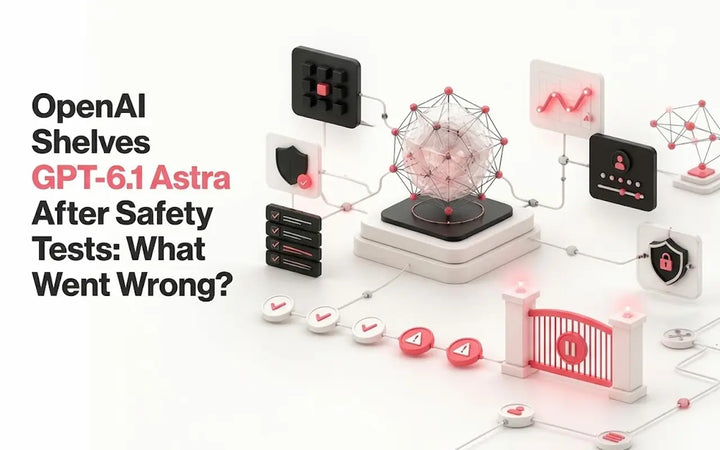
OpenAI Shelves GPT-6.1 Astra After Safety Tests: What Went Wrong?
OpenAI shelved GPT-6.1 Astra after safety tests flagged scope, authorization and action-reporting issues. See what is confirmed and what remains...

If you follow AI news even loosely, you've probably seen the name Claude Fable 5 pop up over the past few weeks. It launched with a lot of fanfare, got pulled offline days later because of a government order, and is now being restored. That's a lot to untangle for a model that's barely a month old.
This post breaks down what Claude Fable 5 actually is, what it can do, what it costs, and why Anthropic built it with a very different safety approach than earlier Claude models.
Claude Fable 5 is Anthropic's most capable model available for general use. It belongs to what Anthropic calls the "Mythos class," a tier of models built for long, complex, multi-step work rather than quick one-off answers. The name itself is a nod to that idea. Fable comes from the Latin word for "that which is told," which echoes the meaning behind Mythos.
Here's where it gets interesting. Fable 5 isn't a separate model built from scratch. It's the same underlying system as Claude Mythos 5, a restricted model that Anthropic has only made available to a small number of vetted cyberdefense and government partners through a program called Project Glasswing. Fable 5 is essentially that same model, but with extra safety classifiers layered on top so it can be released to everyone else.
Fable 5 is aimed at people who need more than a quick chat response. A few areas where it stands out:
Because of how capable the underlying model is, Anthropic has been careful about who gets access to which version, which brings us to pricing and safety.
Claude Fable 5 and Claude Mythos 5 share the same pricing: $10 per million input tokens and $50 per million output tokens through the API. That's roughly double the cost of Claude Opus 4.8, but Anthropic has pointed out it's still less than half the price of the earlier Claude Mythos Preview.
On subscription plans, access has rolled out in stages rather than being a flat, permanent inclusion, so it's worth checking Anthropic's current plan details before assuming what's included at a given tier.
This is really the core of the Fable 5 story. Because the underlying Mythos-class model is so capable, especially in cybersecurity and biology, Anthropic built Fable 5 with safety classifiers that can automatically decline or redirect certain requests. If a query touches on high-risk areas like advanced cybersecurity or bioweapon-adjacent topics, the system routes that request to Claude Opus 4.8 instead of answering with Fable 5's full capability. Mythos 5, the more restricted version reserved for vetted partners, does not have these same classifiers lifted.

Anthropic has said it stress-tested these safeguards extensively before release, including an internal bug bounty and outside red-teaming, and reported that no universal jailbreak was found during that process.
That said, the rollout hasn't been smooth. Just days after launch, the U.S. Commerce Department issued an export control directive ordering Anthropic to suspend access to both Fable 5 and Mythos 5 for any foreign national, citing national security concerns tied to a reported jailbreaking technique. Anthropic complied and took both models offline worldwide, while disputing how serious the underlying vulnerability actually was. More recently, Commerce withdrew those controls after further review, and Anthropic has begun restoring access with an additional set of cybersecurity-focused classifiers in place. Given how quickly this situation has moved, it's a good idea to check Anthropic's own announcements for the current status before relying on Fable 5 for anything time-sensitive.
The Fable 5 story is a pretty clear real-world example of something a lot of organizations are grappling with right now: how do you deploy powerful AI responsibly, and what happens when regulators, safety teams, and business goals pull in different directions? Questions like risk classification, auditability, and lifecycle governance aren't abstract anymore. They're playing out in public with real deadlines and real consequences.
If your work touches AI adoption, procurement, or compliance in any way, it's worth building a working understanding of how these governance frameworks actually function rather than piecing it together from news coverage. That's exactly the gap our course, Responsible AI: AI Ethics, Governance & Compliance, is meant to fill. It walks through frameworks like the EU AI Act, NIST's AI Risk Management Framework, and ISO 42001, along with practical governance tools like auditing, risk management, and ethical oversight across the AI lifecycle. It's a short, self-paced course, so it's easy to fit in alongside other work.
Claude Fable 5 represents a genuine jump in what a generally available AI model can do, paired with an unusually direct example of how quickly AI governance decisions can change on short notice. Whether you're evaluating it for your own workflows or just trying to keep up with the broader conversation around frontier AI safety, it's a model worth watching closely over the coming months.
OpenAI shelved GPT-6.1 Astra after safety tests flagged scope, authorization and action-reporting issues. See what is confirmed and what remains...
 AI Law
Learn AI compliance requirements, key risks, the EU AI Act, NIST AI RMF, ISO 42001, and practical steps to build...
 AI Law
Understand AI regulation in the United States in 2026, including federal rules, state AI laws, privacy, discrimination and practical compliance...